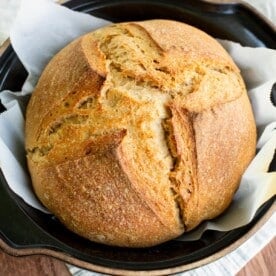
Einkorn Sourdough Bread
This rustic einkorn sourdough loaf is nutty, tender, and full of flavor. It’s naturally fermented, easy to slice, and kid approved, especially slathered with butter or served alongisde soup.
Servings: 12 slices
Ingredients
Levain (takes 10-12 hours until peaked, bubbly and active at 78°F)
- 5 grams sourdough starter about 1 teaspoon, ripe, bubbly and active
- 50 grams all-purpose or bread flour heaping 1/3 cup, or substitute Einkorn flour, see recipe notes
- 50 grams water about 3 Tablespoons
Einkorn Sourdough Bread
- 100 grams levain
- 300 grams water
- 10 grams salt
- 250 grams Einkorn berries see recipe notes
- 250 grams bread flour
Instructions
Mix Levain (takes 10-12 hours at 78ºF until peaked and active)
- Mix together ripe sourdough starter, flour and water. Set aside to ripen for 10-12 hours at 78°F. The levain is ready when it has doubled in size, is peaked, bubbly, active and has a milky sweet aroma.Note: You can mix the levain with einkorn flour if desired or a combination of einkorn and bread flour - note the rise time will be faster if using einkorn in the starter.
Sourdough Einkorn Bread
- Mill the Berries: Mill the einkorn berries using a grain mill. Measure out 250 grams of einkorn berries and mill into einkorn flour on a fine setting. You will have 250 grams of einkorn flour.Note: If you mill extra einkorn berries, use it right away or store in an air-tight container in the freezer. You can also use pre-milled einkorn flour in this recipe.
- Mix Dough: To a large bowl, mix together ripe levain with water. Whisk together until mostly combined. Then add salt, einkorn flour, and bread flour. Mix using a dough whisk or spoon until a wet and sticky dough forms and the ingredients are fully combined. Cover and let rest for 30 minutes.
- Stretch and Folds: After the dough has rested, you will perform a series of “stretch and folds” over the next 1 ½ hours. The goal is to strengthen the dough through a gentle kneading process. Einkorn has a weaker gluten structure, so it will be very sticky and doesn't need much kneading. To “stretch and fold,” wet your hand (so it doesn’t stick to the dough - Einkorn can be especially sticky and a slightly damp hand helps). Reach around the dough down to the bottom of the bowl, pull the dough up and over, and place it on top of the dough. Turn the bowl a quarter turn and repeat the stretch and fold. Turn another quarter turn and repeat. Perform one more quarter turn, stretching and folding the dough. Cover and set aside. Take note of how the dough feels through this process. It will go from feeling a little shaggy to smooth and elastic, though fairly sticky. Cover the bowl and wait about 30 minutes between stretch and folds.
- Stretch and fold #1: 30 minutes into bulk fermentationStretch and fold #2: 30 minutes later, the dough will spread out. Stretch and fold again.Stretch and fold #3: 30 minutes later, stretch and fold again.Stretch and fold #4: 30 minutes later, stretch and fold again. You should notice the dough feeling more cohesive and strong during this stretch and fold, and not needing very much folding to come together. If your dough still feels loose, add in another couple of stretch and folds to help strengthen and tighten the gluten strands.
- Rest: Cover the dough and let rise for 2-2.5 more hours at 78ºF. You’ll know the dough is ready to shape when the dough is puffed up about 40%, jiggles when you shake the bowl, and it may have a few scattered bubbles visible on the sides and top.If your dough is cooler, this will take longer and you will want to look for a larger percentage rise before shaping the dough.
- Shape the Dough: Line a bowl or banneton with a kitchen towel or a hair net (my favorite for sticky doughs like einkorn). Flour it generously with rice flour or einkorn to prevent sticking. Turn the dough out onto a clean, lightly floured surface (if desired) by tipping the bowl upside down and letting it gently fall out. Try not to deflate it. Use damp hands and a bench knife to begin shaping the dough by gently tucking the edges underneath, going around in a circle to build surface tension and form a round ball. As you work, gently pull the dough toward you and fold it over itself to tighten the shape.Once shaped, lift and flip the dough into the prepared bowl, placing it seam side up in the bowl. Cover with plastic wrap or a plastic shower cap.Note: I skip the pre-shaping for this loaf because the dough can be quite sticky and difficult to handle, especially if you're making it with 100% einkorn flour. Add in a pre-shape for 30 minutes if desired.
- Rise: Set the dough in a warm, 78ºF spot and let rise for 1 1/2 – 2 hours until puffed up in the banneton another 20-30%. Place in the refrigerator for 1-2 hours to chill slightly before baking.Note: If you want to cold ferment the dough, skip the warm rise and place it directly in the refrigerator. You will also want to alter your timeline, mixing the dough later in the day so the dough doesn't over-proof in the refrigerator. I would not cold ferment this loaf longer than 12 hours for best results/oven-spring.
- Preheat the oven: Put a Dutch oven (top and all) into the oven and preheat to 500°F for 20 minutes. You are working with very high temperatures, so make sure you have some good hot pads. Once preheated for 20 minutes, pull the loaf out of the refrigerator. Remove the covering. Place a piece of parchment paper on top of the dough. Flip the dough over so it is now sitting on the parchment paper. Take off the bowl/banneton and the kitchen towel.
- Scoring: Use a very sharp knife or bread lame to score the dough. Take the bread lame and score on one side of the dough, at a shallow angle, about 30º and 1 inch deep. Score straight from the refrigerator on the cold dough for best results.
- Baking: Carefully remove the Dutch oven from the 500°F oven. Take the lid off and place your bread into the Dutch oven (including parchment paper – this helps with the transfer). Put the lid on and put it back in the oven. Lower the temperature to 450°F and bake for 25 minutes. After 25 minutes, take the lid off the Dutch oven and bake for 20 more minutes. The bread is finished baking when it reaches an internal temperature of about 205ºF. Remove the bread from the Dutch oven to a cooling rack and let the bread cool completely before slicing. Enjoy!
Notes
Note: Einkorn is notoriously sticky to work with. I use a much lower hydration in this dough to make it easier to work with, though it is still a sticky dough. Wet your hand before working with einkorn. It also tends to ferment a little faster at warm temperatures. Follow the temperature guidelines or bake the same day so your dough doesn't overproof.
All-Purpose Einkorn Flour: Some stores will carry all-purpose einkorn flour. You can substitute that for the berries if preferred. The texture with the bran and germ removed will be a little softer.
Bread Flour: 100% einkorn Flour can be substituted in this recipe making it a 100% einkorn loaf. If you do this, I would decrease the water to 290 grams (instead of 300 grams) and bake the loaf in a bread pan to give more structure and support to the dough. Be aware that your dough will be much stickier, and you will want to wet your hands before handling the dough.
Sourdough Starter: If you already have ripe, bubbly, active sourdough starter, you can substitute it for the levain in this recipe.
Einkorn Levain: You can substitute einkorn flour in the levain if desired. It will ferment a little bit faster if kept at the same temperature. Either decrease the temperature of the water or feed the starter a little bit later in the timeline to account for this.
Cold Fermentation: With ancient grains like einkorn, I usually skip a cold ferment since the loaves can overproof easily. If you do want to cold ferment, mix the dough in the evening and bake it in the morning—just keep it under 12 hours in the fridge.
Parchment Paper: Not all parchment paper is created equal. Use a good-quality parchment paper that won't stick to the bread or try a silicone bread sling.
Nutrition
Calories: 174kcal | Carbohydrates: 36g | Protein: 5g | Fat: 1g | Saturated Fat: 0.1g | Polyunsaturated Fat: 0.3g | Monounsaturated Fat: 0.1g | Sodium: 325mg | Potassium: 48mg | Fiber: 1g | Sugar: 0.1g | Vitamin A: 0.4IU | Calcium: 8mg | Iron: 1mg
