
Affiliate disclosure: This post may contain affiliate links. Please see our disclosure policy.
Baking Einkorn Sourdough Bread is one of the most rewarding ways to enjoy ancient grains. Einkorn’s rich, slightly sweet flavor and naturally buttery texture make it a perfect match for sourdough fermentation. In this recipe, I use a combination of freshly milled einkorn flour and bread flour to create a loaf with excellent structure and all the wholesome benefits of einkorn.
While einkorn dough can be a little sticky to handle, the results are worth it. It’s a soft, flavorful bread that’s as nourishing as it is delicious. This guide will walk you through the process step-by-step so you can master sourdough with einkorn flour in your own kitchen.

Save this for later!
Table of Contents
- Why You’ll Love Einkorn Sourdough
- Why I Bake with Einkorn
- Important Ingredients
- Substitutions
- Half Einkorn Loaf VS. 100% Einkorn Loaf
- Sourdough Baker’s Timeline
- How to Make Einkorn Sourdough Bread
- How to Store Leftovers
- Amy’s Recipe Tip
- Frequently Asked Questions
- Whole Grain Sourdough Recipes
- Einkorn Sourdough Bread Recipe
Why You’ll Love Einkorn Sourdough
- Flavor – Einkorn gives this loaf a really great nutty, hearty flavor similar to my Whole Wheat Sourdough Bread.
- Vitamins & Minerals – Whole grain einkorn flour is naturally rich in beta-carotene, vitamin A, lutein, riboflavin (vitamin B2), and trace minerals like iron and manganese. Like my Multigrain Sourdough Bread, it’s a wholesome choice packed with flavor and nutrition.
- Primitive Form of Wheat – Einkorn is genetically closest to the wild wheat that was first cultivated with only 14 chromosomes, while modern wheat has 42. That makes it easier on the digestive system.
- Lower Gluten Content – Einkorn contains fewer glutenin proteins than modern wheat, giving it a weaker gluten structure and making it easier to digest for some people with gluten sensitivities. While it’s not gluten-free, pairing einkorn with sourdough fermentation can create a loaf that’s gentler on the stomach for many.
- Organic – One of the things I love about baking with whole wheat flour is the health benefits. Einkorn is a “hulled” grain, which means it is encased in a husk as it grows. This protects it from a lot of harmful contamination and insects, making it easier to keep growing einkorn organically.
New to Sourdough? If you are new to sourdough, learn how to make a sourdough starter from scratch and check out my Free Sourdough Beginner Guide. Using naturally fermented sourdough will take much longer, but you will love the fermentation benefits and the flavor!
Why I Bake with Einkorn
I love the nutritional benefits of baking with an ancient grain like Einkorn. Just like with my Spelt Sourdough Bread, this recipe uses ancient grains for a hearty and nutrient-dense loaf.
Einkorn is the most primitive form of wheat, meaning it has a different gluten structure than the whole wheat bread you can find in most grocery stores today. While it isn’t gluten-free, many people feel they can tolerate einkorn better than modern wheat flour. It’s also full of nutrients, adding depth of flavor and a wholesome quality to your sourdough bread.
Important Ingredients

- Einkorn Berries – I typically purchase einkorn berries from Grand Teton Ancient Grains because I love their quality. I like to mill my own einkorn flour using a home Harvest Grain Mill.
- Bread Flour – A combination of einkorn berries and bread flour is perfect for beginners. Adding bread flour helps give the loaf more structure and rise, balancing out einkorn’s reduced gluten structure.
- Sourdough Starter – Use an active/ripe sourdough starter (doubled in size/bubbly/mild sour aroma) to mix the levain. I use my regular sourdough starter to mix this levain. If you maintain a whole wheat or einkorn starter, you can use that too.
- Salt – With so few ingredients, you don’t want to leave out the salt! It balances the flavors and fermentation in this loaf.
See the recipe card for full information on ingredients and quantities
Substitutions
- Einkorn berries: Substitute 100% einkorn berries for the bread flour. The loaf won’t rise quite as high and will be stickier to work with. I recommend reducing the water to 290 grams and baking the bread in a loaf pan for best results.
- Einkorn flour: If you don’t have a grain mill, substitute equal weights of einkorn flour for the einkorn berries.
- Levain: Mix an einkorn levain by substituting einkorn flour instead of your regular all-purpose flour. This isn’t necessary, but adds to the richness of the flavor and nutrition of the loaf.
- Inclusions: I haven’t added inclusions to this dough yet, but I think it could hold some fresh herbs, a sprinkle of cheese or even some dried fruit fairly well. I would add them in during the second set of stretch and folds, similar to how I add inclusions into my sourdough loaves.
Half Einkorn Loaf VS. 100% Einkorn Loaf
You can absolutely make this a 100% einkorn sourdough loaf by substituting all of the bread flour with einkorn flour. It gives a nutty flavor and even easier digestion. Just keep in mind that einkorn behaves very differently than modern wheat. It’s a much stickier dough and has a more delicate gluten structure. Because of that, I recommend a few adjustments to help you get the best results:
- Lower the hydration: Reduce the water to 290 grams (instead of 300 g) to make the dough more manageable.
- Use a bread pan: Since einkorn dough tends to spread more than rise, baking it in a pan will give your loaf better shape and structure.
- Wet your hands: Always wet your hands before handling the dough. This makes shaping easier and helps prevent sticking.
- Watch your fermentation time: Einkorn tends to ferment a bit faster, especially in warm temperatures. Be sure to follow temperature guidelines and consider baking the same day to avoid overproofing.
You can use either freshly milled whole einkorn flour or all-purpose einkorn flour (which has the bran and germ removed). The all-purpose version will give a slightly softer, lighter texture, while whole-grain einkorn adds more flavor and nutrition.
With a few tweaks, einkorn can make a beautifully flavorful and nourishing loaf—just be ready for a stickier (but totally worth it) dough experience.


Sourdough Baker’s Timeline
Because sourdough takes time to rise, I include sourdough sample schedules in my sourdough recipes. These schedules are not meant to be followed exactly but rather give you an idea of a timeline, which is very dependent on the temperature of your dough/starter and the activity of your starter.
Note: The schedule assumes a dough temperature of 76-80ºF. I hope it’s helpful to you.
| Day 1 | Mix Levain |
| 9:00 PM – 9:00 AM | Mix Levain Let Rise Overnight at 78ºF Note: You can use a ripe, bubbly, active sourdough starter in place of the levain. An 100% einkorn levain will be ready a few hours sooner. |
| Day 2 | Mix Dough/Bulk Fermentation/Folds/Shape/Cold Fermentation |
| 9:00 AM | Mix the Dough |
| 9:30 AM | Stretch and Fold #1 |
| 10:00 AM | Stretch and Fold #2 |
| 10:30 AM | Stretch and Fold #3 |
| 10:30 AM – 1:00 PM | Rest and complete bulk fermentation at 78ºF |
| 1:00 PM – 2:30 PM | Shape and rise |
| 2:30 – 4:30 PM | Refrigerate |
| 4:30 PM | Bake |
How to Make Einkorn Sourdough Bread
Mix the Levain

Step 1: Mix Levain. Combine ripe sourdough starter with flour and water (Image 1). Cover and let rise overnight (for about 10-12 hours) at 78ºF until peaked, active and bubbly (Image 2).
Sourdough Starter?: If you have a ripe, bubbly, active sourdough starter that is fed equal parts flour and water – it can be substituted for the levain in this recipe. You can also substitute einkorn flour for the all-purpose flour in the levain, just watch your fermentation time as it will move faster.
Mill the Einkorn Berries

Step 2: Mill the Berries. Once your levain is ready to be mixed into the dough, use a grain mill to mill the einkorn berries on a fine setting for best texture (Images 3 & 4). 250 grams of einkorn berries is roughly equivalent to 250 grams of flour.
Extra Einkorn Flour? If you mill extra einkorn flour, use it right away or store in an air-tight container in the freezer. You can also use pre-milled einkorn flour in this recipe.
Mix the Dough

Step 3: Mix Dough. When your levain is ripe, bubbly, doubled in size and active, it’s time to mix your dough. Mix the ripe levain and water in a large mixing bowl (Image 5). Whisk together until mostly combined before adding the freshly milled einkorn flour, bread flour, and salt (Image 6). Mix until it forms a wet sticky dough (Images 7 & 8). Cover the mixture and let sit for 30 minutes at around 78°F.
Want a 100% Einkorn Loaf? Leave out the bread flour and build your levain with einkorn flour. Reduce the water to 290 grams (instead of 300 g). Einkorn doesn’t absorb as much water as modern wheat, so it does better with slightly lower hydration.
Bulk Fermentation

Step 4: Bulk Fermentation. In artisan bread baking, we skip traditional kneading and instead use a series of gentle folds to strengthen the gluten. For this dough, aim for 3–4 sets of stretch and folds over a 1 1/2 to 2-hour period if your dough is around 78°F. Cover the dough and rest it for 30 minutes between each set. Einkorn has a weaker gluten structure than traditional wheat bread, so the dough will be quite sticky. It will become more cohesive over time, but it’s very important to wet your hands each time you perform a stretch and fold to limit the dough from sticking to your hands.
Stretch and Fold: To perform a stretch and fold, wet your hand to prevent sticking. Reach down to the bottom of the dough, gently stretch it upward (Image 9), and fold it over the top (Image 10). Rotate the bowl a quarter turn and repeat (Image 11). Do this a total of four times (one full rotation). Cover and let rest for 30 minutes, then repeat every 30 minutes for a total of 3–4 rounds. –> Watch the stretch and fold process here.
Step 5: Rest. After completing the stretch and folds, allow the dough to finish bulk fermentation by resting in a warm spot (around 78–80°F) until it has risen about 40% and looks puffed up (Image 12). The surface should appear smooth, jiggly, puffy and risen. It may have a few scattered bubbles along the edges. This rest typically takes 2 to 2.5 hours at 78°F, but check in often to assess readiness.
Shape the Dough

Step 6: Shape Dough. I don’t recommend pre-shaping the dough like I do with a classic sourdough loaf because the einkorn makes a stickier dough that can be harder to work with. Prepare a banneton basket (either a batard or boule shape). Place a kitchen towel or hair net in the bowl and sprinkle with flour (Image 13). Pull the dough out of the bowl (Image 14) and place it on a clean countertop surface (Image 15).

Pull the dough down toward you and then fold up to the middle of the dough (Image 16). Continue gathering the bread into a circle until it is gathered together into a circle (Images 17 – 20). Pinch the seam closed. Use a bench knife to lift the bread and place into your lined bowl or proofing basket (Images 21 & 22).

Final Proof (Second Rise)

Step 7: Rise. Cover the shaped dough with plastic wrap, a bowl cover, or a shower cap and let it rise in a warm spot (around 78°F) for 1½ to 2 hours. It’s ready when it looks puffed and has risen about 20% (Images 23 & 24). Refrigerate for 1–2 hours to help firm up the dough before scoring and baking.
Can I cold ferment this dough? With freshly milled grains, a long cold fermentation can easily lead to overproofing and a much stronger sour flavor. If you’d still like to cold ferment the dough, refrigerate right after shaping for no longer than 12 hours.
Baking Einkorn Sourdough Bread

Step 8: Bake. Place a Dutch oven (lid and all) into your oven and preheat to 500°F.
Scoring the Dough: Once the oven has preheated for 30 minutes, remove the loaf from the refrigerator. Take off the plastic wrap or cover. Place a piece of high quality parchment paper over the dough, then flip it so the dough sits on the parchment. Remove the bowl or banneton and kitchen towel. Lightly dust the top with flour for contrast (or skip it if you prefer no contrast). Use a bread lame or sharp knife to score the dough (Images 25 & 26).
Baking the Bread: Using oven mitts, carefully remove the Dutch oven from the 500°F oven. Take off the lid and gently place the bread inside—parchment paper and all. Be cautious not to touch the hot sides. Put the lid back on and return the Dutch oven to the oven (Image 27).
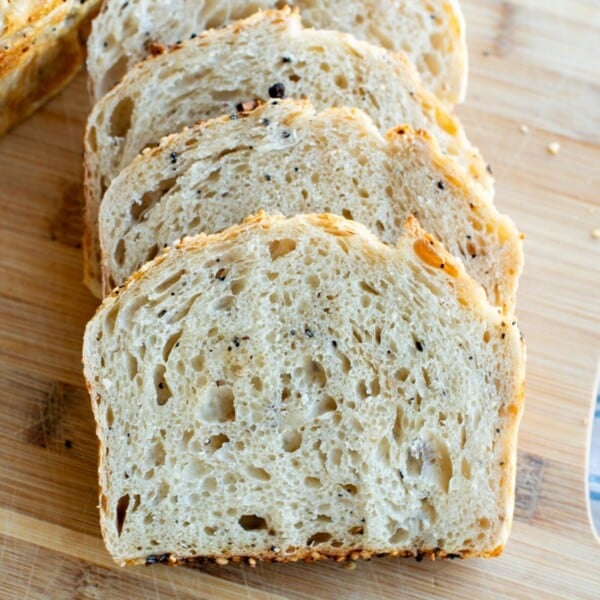
Lower the temperature to 450°F and bake for 25 minutes. Then, remove the lid and bake uncovered for another 20 minutes, or until the crust is deeply golden and the loaf is fully baked. The internal temperature should be between 205–210°F. Remove the bread to a wire rack and let the bread cool completely before slicing (Image 28).
No Dutch Oven? You can also bake this sourdough einkorn bread in a loaf pan for sandwich-style slices. It won’t have quite the same crust as a Dutch oven bake, but it still makes a delicious loaf perfect for everyday use.
How to Store Leftovers
Once this einkorn sourdough loaf has cooled completely, slice it and store the slices in a freezer-safe bag. Freeze for up to 1–2 months. When you’re ready to eat, just toast a slice straight from the freezer or let it thaw at room temperature before opening a jar of jam and slathering on some butter, jam and a sprinkle of sea salt – yum!
Amy’s Recipe Tip
Ancient grains like einkorn have a more delicate gluten structure than modern wheat, which means this loaf is stickier. Try not to overwork the dough, and make sure you wet your hands before working with it.
Frequently Asked Questions
No, einkorn is not gluten-free. It’s an ancient grain that has NOT been hybridized with modern wheat varieties, making it a more traditional form of wheat. While it contains gluten, its weaker gluten structure, especially when fermented with sourdough, may be easier to digest for some people.
Einkorn has a weaker gluten network as an ancient grain than modern wheat, so I haven’t found much benefit from an extended autolyse. The sourdough process already hydrates the grain well and I prefer not to autolyse this loaf of bread.
If you already have a sourdough starter, you can transition to feeding it einkorn flour, but I prefer to mix a levain for my einkorn bread. Use your existing sourdough starter to mix your levain using einkorn flour and water. This will give you an almost 100% einkorn levain (starter) to use in your dough.
Yes, you can add inclusions to this einkorn sourdough bread just like you would with any classic sourdough loaf.

Whole Grain Sourdough Recipes


If you tried this Einkorn Sourdough Bread or any other recipe on my website leave a 🌟 star rating and let me know how it went in the comments below. Happy Baking!

Einkorn Sourdough Bread
Save this for later!
Ingredients
Levain (takes 10-12 hours until peaked, bubbly and active at 78°F)
- 5 grams sourdough starter, about 1 teaspoon, ripe, bubbly and active
- 50 grams all-purpose or bread flour, heaping 1/3 cup, or substitute Einkorn flour, see recipe notes
- 50 grams water, about 3 Tablespoons
Einkorn Sourdough Bread
- 100 grams levain
- 300 grams water
- 10 grams salt
- 250 grams Einkorn berries, see recipe notes
- 250 grams bread flour
Instructions
Mix Levain (takes 10-12 hours at 78ºF until peaked and active)
- Mix together ripe sourdough starter, flour and water. Set aside to ripen for 10-12 hours at 78°F. The levain is ready when it has doubled in size, is peaked, bubbly, active and has a milky sweet aroma.Note: You can mix the levain with einkorn flour if desired or a combination of einkorn and bread flour – note the rise time will be faster if using einkorn in the starter.
Sourdough Einkorn Bread
- Mill the Berries: Mill the einkorn berries using a grain mill. Measure out 250 grams of einkorn berries and mill into einkorn flour on a fine setting. You will have 250 grams of einkorn flour.Note: If you mill extra einkorn berries, use it right away or store in an air-tight container in the freezer. You can also use pre-milled einkorn flour in this recipe.
- Mix Dough: To a large bowl, mix together ripe levain with water. Whisk together until mostly combined. Then add salt, einkorn flour, and bread flour. Mix using a dough whisk or spoon until a wet and sticky dough forms and the ingredients are fully combined. Cover and let rest for 30 minutes.
- Stretch and Folds: After the dough has rested, you will perform a series of “stretch and folds” over the next 1 ½ hours. The goal is to strengthen the dough through a gentle kneading process. Einkorn has a weaker gluten structure, so it will be very sticky and doesn't need much kneading. To “stretch and fold,” wet your hand (so it doesn’t stick to the dough – Einkorn can be especially sticky and a slightly damp hand helps). Reach around the dough down to the bottom of the bowl, pull the dough up and over, and place it on top of the dough. Turn the bowl a quarter turn and repeat the stretch and fold. Turn another quarter turn and repeat. Perform one more quarter turn, stretching and folding the dough. Cover and set aside. Take note of how the dough feels through this process. It will go from feeling a little shaggy to smooth and elastic, though fairly sticky. Cover the bowl and wait about 30 minutes between stretch and folds.
- Stretch and fold #1: 30 minutes into bulk fermentationStretch and fold #2: 30 minutes later, the dough will spread out. Stretch and fold again.Stretch and fold #3: 30 minutes later, stretch and fold again.Stretch and fold #4: 30 minutes later, stretch and fold again. You should notice the dough feeling more cohesive and strong during this stretch and fold, and not needing very much folding to come together. If your dough still feels loose, add in another couple of stretch and folds to help strengthen and tighten the gluten strands.
- Rest: Cover the dough and let rise for 2-2.5 more hours at 78ºF. You’ll know the dough is ready to shape when the dough is puffed up about 40%, jiggles when you shake the bowl, and it may have a few scattered bubbles visible on the sides and top.If your dough is cooler, this will take longer and you will want to look for a larger percentage rise before shaping the dough.
- Shape the Dough: Line a bowl or banneton with a kitchen towel or a hair net (my favorite for sticky doughs like einkorn). Flour it generously with rice flour or einkorn to prevent sticking. Turn the dough out onto a clean, lightly floured surface (if desired) by tipping the bowl upside down and letting it gently fall out. Try not to deflate it. Use damp hands and a bench knife to begin shaping the dough by gently tucking the edges underneath, going around in a circle to build surface tension and form a round ball. As you work, gently pull the dough toward you and fold it over itself to tighten the shape.Once shaped, lift and flip the dough into the prepared bowl, placing it seam side up in the bowl. Cover with plastic wrap or a plastic shower cap.Note: I skip the pre-shaping for this loaf because the dough can be quite sticky and difficult to handle, especially if you're making it with 100% einkorn flour. Add in a pre-shape for 30 minutes if desired.
- Rise: Set the dough in a warm, 78ºF spot and let rise for 1 1/2 – 2 hours until puffed up in the banneton another 20-30%. Place in the refrigerator for 1-2 hours to chill slightly before baking.Note: If you want to cold ferment the dough, skip the warm rise and place it directly in the refrigerator. You will also want to alter your timeline, mixing the dough later in the day so the dough doesn't over-proof in the refrigerator. I would not cold ferment this loaf longer than 12 hours for best results/oven-spring.
- Preheat the oven: Put a Dutch oven (top and all) into the oven and preheat to 500°F for 20 minutes. You are working with very high temperatures, so make sure you have some good hot pads. Once preheated for 20 minutes, pull the loaf out of the refrigerator. Remove the covering. Place a piece of parchment paper on top of the dough. Flip the dough over so it is now sitting on the parchment paper. Take off the bowl/banneton and the kitchen towel.
- Scoring: Use a very sharp knife or bread lame to score the dough. Take the bread lame and score on one side of the dough, at a shallow angle, about 30º and 1 inch deep. Score straight from the refrigerator on the cold dough for best results.
- Baking: Carefully remove the Dutch oven from the 500°F oven. Take the lid off and place your bread into the Dutch oven (including parchment paper – this helps with the transfer). Put the lid on and put it back in the oven. Lower the temperature to 450°F and bake for 25 minutes. After 25 minutes, take the lid off the Dutch oven and bake for 20 more minutes. The bread is finished baking when it reaches an internal temperature of about 205ºF. Remove the bread from the Dutch oven to a cooling rack and let the bread cool completely before slicing. Enjoy!
Notes
Nutrition
Nutrition information is automatically calculated, so should only be used as an approximation.


I’m just now using this recipe as I’ve baked a lot of 100% fresh milled einkorn and truly love it, but decided I want a little more rise in my next loaf (this one) just for fun and a change. Question- while the einkorn doesn’t need much handling, what about the bread flour? Is it just a matter of sacrificing developing the gluten in it for the sake of the einkorn? I haven’t seen anyone address this yet. Just wondering.
That’s a good question. The bread flour does add some strength, but it won’t behave like a typical high-gluten dough. I wouldn’t aggressively develop gluten — just a few gentle stretch and folds is enough. Overworking it can still break down the einkorn structure.
Can I make this recipe with 100% einkorn flour (using normal wheat flour starter) AND add butter like your croissant bread loaf recipe?
I haven’t tried that, but it’s an interesting idea! The problem I could see would be that einkorn typically has a faster rise time, and the croissant bread requires a slower rise at a lower temperature to keep the butter from melting, so you might end up with an overproofed loaf. But let me know if you try it and it turns out well!
I think your recipe is very clear and concise. I loved following it. I used einkorn with a little whole wheat flour after I milled the berries and it wasn’t as sticky as you had mentioned, but I’m very gentle with it. It’s in the Benetton now
I can’t wait to bake this baby in about two hours. Thank you for this wonderful recipe. I look forward to trying your other recipes as well.
I’m glad it was an easy recipe to follow. Thanks for the review!
Under Ingredients it says the levain takes 10-12 hours to peak; under Instructions it says 3-4 hours.
10-12 hours is correct – thanks for catching that typo!
Awesome baking lesson!
So glad you love the recipe – thanks for the review.
I’m not rating the recipe as I’m really (?!) confused…..followed the directions with milling, weighing, levain building, etc….
But my dough was not wet at all with the initial mix – so much that I had to hand mix it to incorporate the flour(s)…..
It’s in its last phase of bulk fermentation now – each time I performed the stretch and folds, it stayed tight….
Can’t imagine what happened…..as I’ve never had a snafoo with your fabulous recipes!
I’m sorry you had trouble with this recipe. Even though this is a lower hydration recipe, it sounds like you might have needed a bit more water initially. I hope you give it another try and that it turns out better the second time. There is a bit of a learning curve to baking with ancient grains, but I hope you find it’s worth it!
Question: after baking for 25 min at 450, should the oven be lower to 425, and bake with lid off? Then take the recipe says to lower again to 450. Doesn’t make sense. Thank you.
Forgive my typos! Stupid autocorrect! Meant to say the recipe says to take the lid off, lower to 450 and bake 25 min. Should it be lower to 425?
Thanks for catching that! It should stay at 450ºF for the whole bake. We’ve gone and fixed the recipe card. So it’s bake at 450ºF with the lid on 25 minutes, then remove the lid and continue baking for another 20 minutes. Sorry that was confusing!
I’m really excited to see you sharing a recipe using fresh milled flour! I have been experimenting with just regular hard white wheat berries but recently started baking with spelt as well as khorasan berries. Do you think either one of these would do well as a substitute for einkorn flour?
I would use this recipe for spelt sourdough: https://amybakesbread.com/spelt-sourdough-bread/ and I have one for Khorosan coming soon. It uses a little bit different method than this einkorn loaf. I also have a lot of whole grain recipes you can find here: https://amybakesbread.com/category/whole-grain-recipes/
Hope that helps!
We really enjoy this loaf and the 100% in a loaf pan.