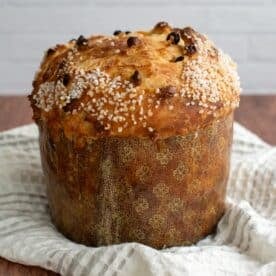
Panettone Sourdough Bread
Soft, airy, and full of buttery sweetness, this Panettone Sourdough Bread uses my croissant-style sourdough dough as the base. It’s an easier, naturally leavened take on classic panettone and the perfect festive bake for the holiday season.
Servings: 16 slices
Equipment
- sourdough tools optional
- panettone mold 750 gram panettone mold
Ingredients
Levain (1:10:10 ratio, 10-12 hours peak at 78-80ºF)
- 6 grams sourdough starter ripe bubbly and active, about 1 teaspoon
- 60 grams all-purpose or bread flour about 1/2 cup
- 60 grams water about 1/4 cup
Panettone Sourdough Bread
- 120 grams levain ripe, bubbly, and active, about ½ cup, see recipe notes
- 325 grams water about 1 1/3 cup
- 60 grams granulated sugar scant 1/3 cup
- 1 egg yolk about 20 grams
- 12 grams Fiori di Sicilia extract about 1 Tablespoon, see recipe notes
- 10 grams salt about 1 1/2 teaspoons
- 500 grams bread flour about 3 1/2 cups
- 113 grams unsalted butter about 1/2 cup, reserved for stretch and folds
- 100 grams golden raisins reserved for stretch and folds, about 3/4 cup
- 150 grams white chocolate chips reserved for stretch and folds, about 1 cup
- swedish pearl sugar for sprinkling on top, optional
Instructions
Levain (1:10:10 ratio, 10-12 hours peak at 78-80ºF)
- Mix together ripe/active sourdough starter with all-purpose or bread flour and water. Cover loosely and let sit 10-12 hours at 78-80°F until doubled, bubbly & peaked.Note: If you have a ripe, bubbly, active sourdough starter that is fed equal parts flour and water, it can be substituted equally for the levain in this recipe.
Panettone Sourdough Bread (Dough temperature kept at 70-72ºF)
- Mix the Dough: To a large bowl, mix together ripe levain with water, egg yolk, sugar, and Fiori di Sicilia extract (see recipe notes). Add the salt and bread flour. Mix together using a dough whisk or spoon until a wet and sticky dough forms and the ingredients are fully combined. Cover and let rest for 30 minutes.Note: This dough is very sensitive to temperature. It's important to maintain a temperature where the dough will rise AND the butter stays chilled and flaky. I've found a 70-72ºF temperature to work the best. I wouldn't go above 75ºF for this recipe, or the butter will get too soft. To do this, use cooler water when mixing your dough, use the refrigerator as needed and take the temperature with a thermometer throughout the process.
- Stretch and Folds: After the dough has rested for 30 minutes, you will perform a series of “stretch and folds” over the next 1 1/2 to 2 hours. The goal is to strengthen the dough through a gentle kneading process. You will also add cold butter, golden raisins, and white chocolate into the dough during this process, which will disperse evenly throughout the dough.To “stretch and fold,” wet your hand (so it doesn’t stick to the dough). Reach around the dough down to the bottom of the bowl, pull the dough up and over, and place it on top of the dough. Turn the bowl a quarter turn and repeat the stretch and fold. Turn another quarter turn and repeat. Perform one more quarter turn, stretching and folding the dough. Cover and set aside. Take note of how the dough feels through this process. It will go from feeling a little shaggy to smooth and elastic. Cover the bowl and wait about 30 minutes in between stretch and folds. Watch the stretch and fold video here.
- Stretch and fold #1: After 30 minutes, perform your first set of stretch and folds. Cover the dough and let rest for 30 minutes.Stretch and fold #2: 30 minutes later, grate the cold butter. Put half of the grated butter on top of the dough. The other half of the butter should be placed in the refrigerator to chill until the next set of folds. Stretch and fold the dough again, incorporating the flakes of butter into the dough. Cover and let rest for 30 minutes.Stretch and fold #3: 30 minutes later, add the rest of the butter to the top of the dough. Stretch and fold again. The butter will continue dispersing throughout the dough. Cover and let rest for 30 minutes.Stretch and fold #4: After 30 minutes, add the white chocolate chips and golden raisins on top of the dough, stretching and folding them in as you go. You should notice the dough feeling more cohesive and strong. If your dough still feels loose, add in another couple of stretch and folds 30 minutes later to help strengthen and tighten the gluten strands and incorporate the white chocolate and raisins even more.
- Rest: Cover the dough and let rise for 6-7 more hours at 70ºF. You will know the dough is ready to shape when the dough has risen about 50%, jiggles when you shake the bowl, and has scattered bubbles visible on the sides and top.Note: This is different than a traditional sourdough loaf because we are working at lower temperatures to keep the butter cold.
- Shape the Dough: Prepare a 750 gram pannetone mold by spraying it with cooking spray. Tip the bowl upside down, allowing the dough to fall onto a clean counter surface. Going around in a circle, pull the dough sideways towards you and then fold up to the top of the round. Move 90 degrees and repeat the same process, pulling the dough sideways and then folding up to the top.Flip the dough over so the seam side is down and drag the dough on the countertop with your hands, sealing the seam and encouraging a circular round. Gather the dough into a circle and place it seam-side down into the mold.Note: You can bake this as a traditional boule and shape it into a circle or oval, placing it in a lined banneton, if you prefer. The dough won't rise quite as much because it doesn't have the mold for structure, but it will still taste delicious. See recipe notes for more details.
- Rise: Cover the dough with plastic wrap or a plastic shower cap. Let the dough rise overnight at 70ºF until risen even or just a little above the pannetone mold. When the dough is at 70ºF, this usually takes about 12-16 hours.
- Score and Bake: Preheat the oven to 350ºF. Place the panettone dough on a baking sheet. Sprinkle pearl sugar on top of the dough if desired. Gently score the top of the dough with a razor blade, making a cross in the top. Bake at 350ºF for 50-55 minutes. The loaf should register 190ºF when it has finished baking.
- Remove to a cooling rack. Let cool completely and then slice into it and enjoy!
Notes
Temperature: Keep your dough around 70–72°F throughout mixing and shaping. If it starts warming up, chill it in the refrigerator for 20–30 minutes to keep the butter from melting and to maintain structure. If the temperature is too warm, the fermentation will speed up.
Overnight Rise: I typically don't recommend an overnight rise on sourdough because it's harder to control the temperature. I have made this loaf at least 20 times, and I have found that if your temperature is cool enough (70ºF), it takes 12-16 hours to fully proof before baking. If your dough is warmer, you may want to stick the dough in the fridge and finish the rise the next day until it has risen above the panettone mold before baking it.
Panettone Mold: I use a panettone mold that holds up to 750 grams because I want it to rise above the mold. If you don't have a panettone mold, you can bake this just as you would my croissant sourdough bread.
Fiori di Sicilia (IMPORTANT): Fiori di Sicilia is an important ingredient in this loaf. After making this recipe about 20 to 30 times, I have found that the extract works best, and the essential oil should be avoided unless you use a very small amount. If you do use the oil, reduce it to 2 to 4 grams because it is extremely strong and can slow the rise of the dough. If you do not have Fiori di Sicilia, you can substitute 10 grams of vanilla extract and the zest of one orange, which will not give quite the same flavor but will still add a bright, citrusy taste.
Golden Raisins: Golden raisins taste sweeter and fruitier than traditional brown raisins, which makes them perfect for this bread. If you want a more traditional flavor, you can substitute candied orange peel (60 grams) and candied lemon peel (40 grams). Laminate candied fruit into the dough after the first rise since the sugar can pull moisture from the dough. Reference the step-by-step photos in this post, but the process is simple: stretch the dough into a rectangle, sprinkle on two-thirds of the candied fruit (and chocolate), fold the dough in thirds, add the remaining fruit, then roll it up and gently shape it into a ball before placing it seam side down in the panettone mold.
Nutrition
Calories: 258kcal | Carbohydrates: 38g | Protein: 5g | Fat: 10g | Saturated Fat: 6g | Polyunsaturated Fat: 1g | Monounsaturated Fat: 3g | Trans Fat: 0.2g | Cholesterol: 29mg | Sodium: 255mg | Potassium: 108mg | Fiber: 1g | Sugar: 13g | Vitamin A: 196IU | Vitamin C: 0.2mg | Calcium: 31mg | Iron: 0.5mg
