
Affiliate disclosure: This post may contain affiliate links. Please see our disclosure policy.
It took me a long time to perfect this recipe for Sourdough English Muffins, but this version is finally the one I come back to again and again. After years of testing, I can confidently say these are the sourdough English muffins I love making and eating the most.
They have that classic chewy crumb with plenty of nooks and crannies. Toast one and spread it with homemade apple butter and it is incredible. I love them with fried eggs for breakfast, but they are just as good eaten plain while they are still warm.
Make a big batch of these sourdough English muffins and keep them on hand whenever a craving hits. If you are short on time, you can also try my Easy No Mixer Sourdough Discard English Muffins for a quicker option. Breakfast is about to get a whole lot better.

Table of Contents
- Quick Look: Sourdough English Muffins
- Why You’ll Love Sourdough English Muffins
- Important Ingredients
- Substitutions
- Sourdough Baker’s Timeline
- How to Make Sourdough English Muffins
- How to Store Leftovers
- How to Get Perfect Sourdough Nooks and Crannies
- Frequently Asked Questions
- Popular Sourdough Breakfast Recipes
- Sourdough English Muffins Recipe
Quick Look: Sourdough English Muffins
- Active Time: 30 minutes
- Fermentation Time: about 20 hours (includes overnight levain and bulk fermentation)
- Cook/Bake Time: 25–30 minutes, total
- Total Time: 21 hours
- Servings: 12 english muffins
- Calories: ~231 kcal per slice (based on nutrition panel)
- Cook Method: pan fried and then baked
- Flavor & Texture: chewy with classic nooks and crannies, lightly crisp outside and soft inside
- Difficulty: Moderate. This naturally leavened sourdough recipe requires an overnight levain and careful proofing, but the steps are simple.
SUMMARIZE AND SAVE THIS RECIPE CONTENT ON:
Save this for later!
Why You’ll Love Sourdough English Muffins
- 100% Sourdough Recipe – These English muffins use sourdough starter for the perfect light and fluffy sourdough bake. If you are looking for a quicker sourdough alternative, then try out these Easy Sourdough Discard English Muffins instead.
- Morning Staple – Sourdough English muffins are a classic breakfast favorite. Toast them and serve with butter, jam, or honey or eat alongside eggs, bacon or ham. If you love a homemade breakfast bake, you will also enjoy my Sourdough Discard Scones.
- Versatile – These sourdough english muffins work with both sweet and savory toppings (and they taste so much better than store-bought!). Add jam or apple butter for something sweet, or make a breakfast sandwich with eggs, cheese and avocado. They are just as versatile as my Easy Homemade Sourdough Bagels and they freeze well for an easy breakfast.
New to Sourdough? If you are new to sourdough, learn how to make a sourdough starter from scratch and check out my Free Sourdough Beginner Guide. Using naturally fermented sourdough will take much longer, but you will love the fermentation benefits and the flavor!
Important Ingredients
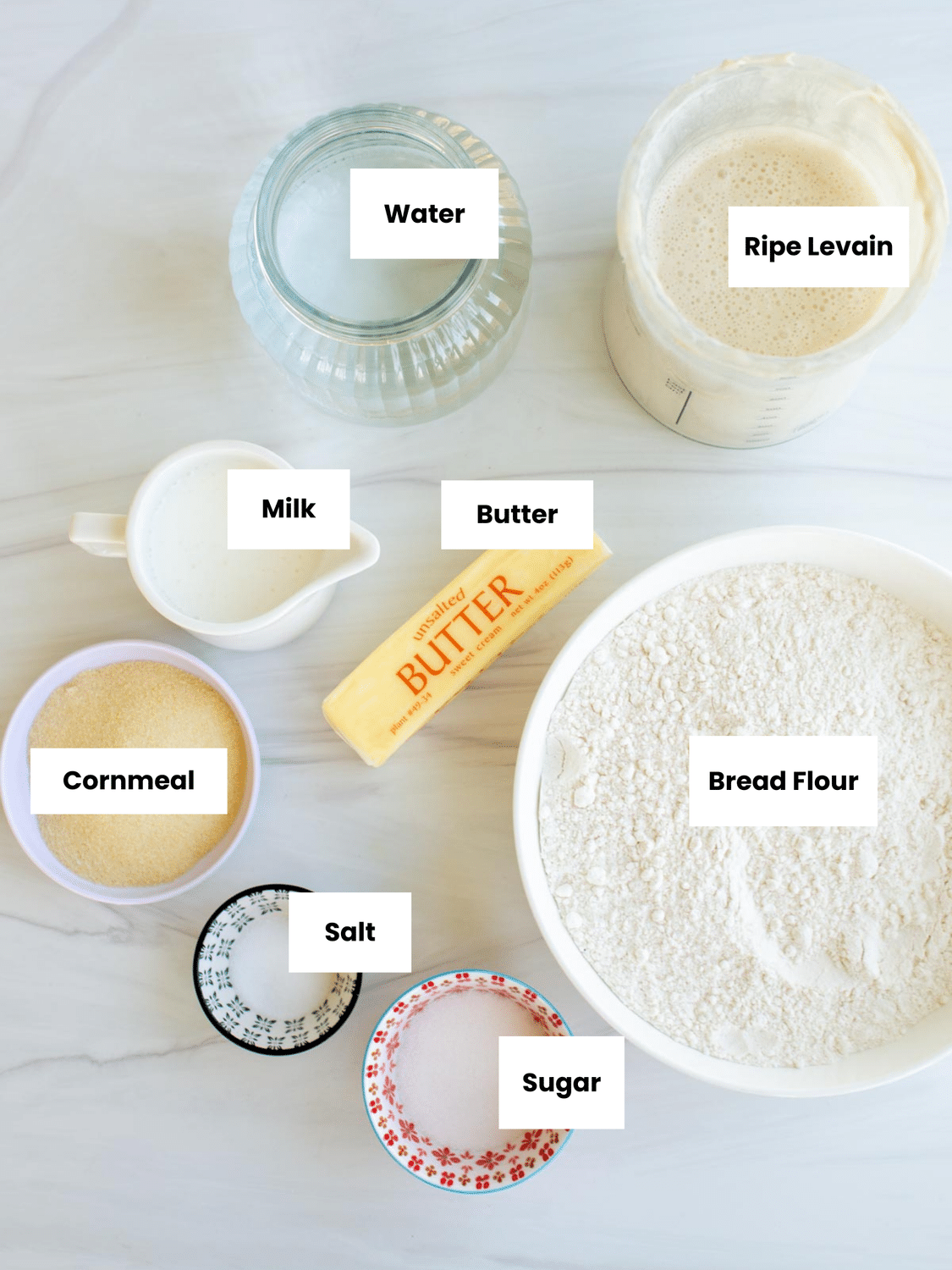
- Sourdough Starter – This recipe uses sourdough starter to make a levain before mixing the dough. Start with an active, ripe sourdough starter (doubled in size/bubbly/mild sour aroma) to mix the levain. If you prefer, you can skip the levain step and substitute active starter directly in the dough in place of the levain.
- Bread flour – Bread flour with a 12.5% protein gives these English muffins their chewy texture and structure.
- Milk and Water– This recipe uses a combination of milk and water. I typically use whole or 2% milk for richness while the water keeps the dough light and balanced.
- Sugar- A small amount of sugar adds flavor and helps the English muffins brown nicely when cooked.
- Butter- Melted butter adds richness and tenderness to the dough while also improving the overall flavor. I use unsalted.
- Salt- Salt balances the flavor and strengthens the dough.
- Cornmeal – Cornmeal is sprinkled on the top and bottom of the English muffins to keep them from sticking to the pan. It also gives them their classic texture. Semolina can be used instead.
See the recipe card for full information on ingredients and quantities
Substitutions
- All-Purpose or Whole Wheat Flour: I prefer bread flour with about 12.5% protein for the best chewy texture in these English muffins. All purpose flour works well too. You may need to add a little extra flour to reach the right dough consistency. You can also substitute up to half whole wheat flour with good results. Whole wheat adds a slightly heartier texture and a bit more sourdough flavor.
- Sugar: You can substitute honey for the sugar if you prefer. You can also leave the sugar out completely. The english muffins will still turn out well but may brown a little less during cooking.
- Milk: I usually use 2% or whole milk, but buttermilk can be used for a slightly tangier flavor. If you substitute buttermilk, reduce the flour slightly to keep the dough balanced.
- Variations: You can easily customize these sourdough English muffins with mix-ins. Try adding cinnamon and raisins for a sweet version, dried blueberries for blueberry flavor, or chopped chives for a savory option that pairs well with eggs and breakfast sandwiches. Add the mix-ins after the first rise when you divide and shape the dough.
Sourdough Baker’s Timeline
A sample baking schedule helps me when baking with sourdough since it takes much longer to rise than traditional yeast bread. Having a timeline makes it easier to plan the bake from start to finish. When my kitchen is cooler, I like to use a bread proofer to help maintain a steady temperature. I will also place my pan of English muffins on a dough mat if needed to keep the dough warm while it rises.
A few notes: This schedule assumes the dough temperature stays around 78-80ºF throughout the process. If your dough is cooler, the fermentation and proofing will take longer. Do not cook these sourdough English muffins until they have puffed up and nearly doubled in size.
| Day 1 | Mix Levain 10-12 hour rise/overnight |
| 8:00 PM – 8:00 AM | Make Levain. Let rise overnight. |
| Day 2 | Mixing/Bulk Fermentation/Shape/Bake |
| 8:00 AM | Mix/Knead Dough Begin Bulk Fermentation (keep dough 78-80 degrees F) |
| 12:00 PM | End Bulk Fermentation Option 1: Shape Rolls and continue with the recipe Option 2: Refrigerate the dough for 12-24 hours and shape rolls the next morning |
| 12:00 PM — 12:15 PM | Separate and shape English muffins |
| 12:15 PM — 3:15PM | Proof/Rise in a warm (80ºF) place for 3-4 hours until puffed up and risen. Do not bake unless dough has puffed up and risen. |
| 3:15 PM — 3:30 PM | Pan cook English muffins over medium-low heat |
| 3:30 PM — 3:45 PM | Bake in preheated 350ºF oven. |
How to Make Sourdough English Muffins
Mixing the Levain
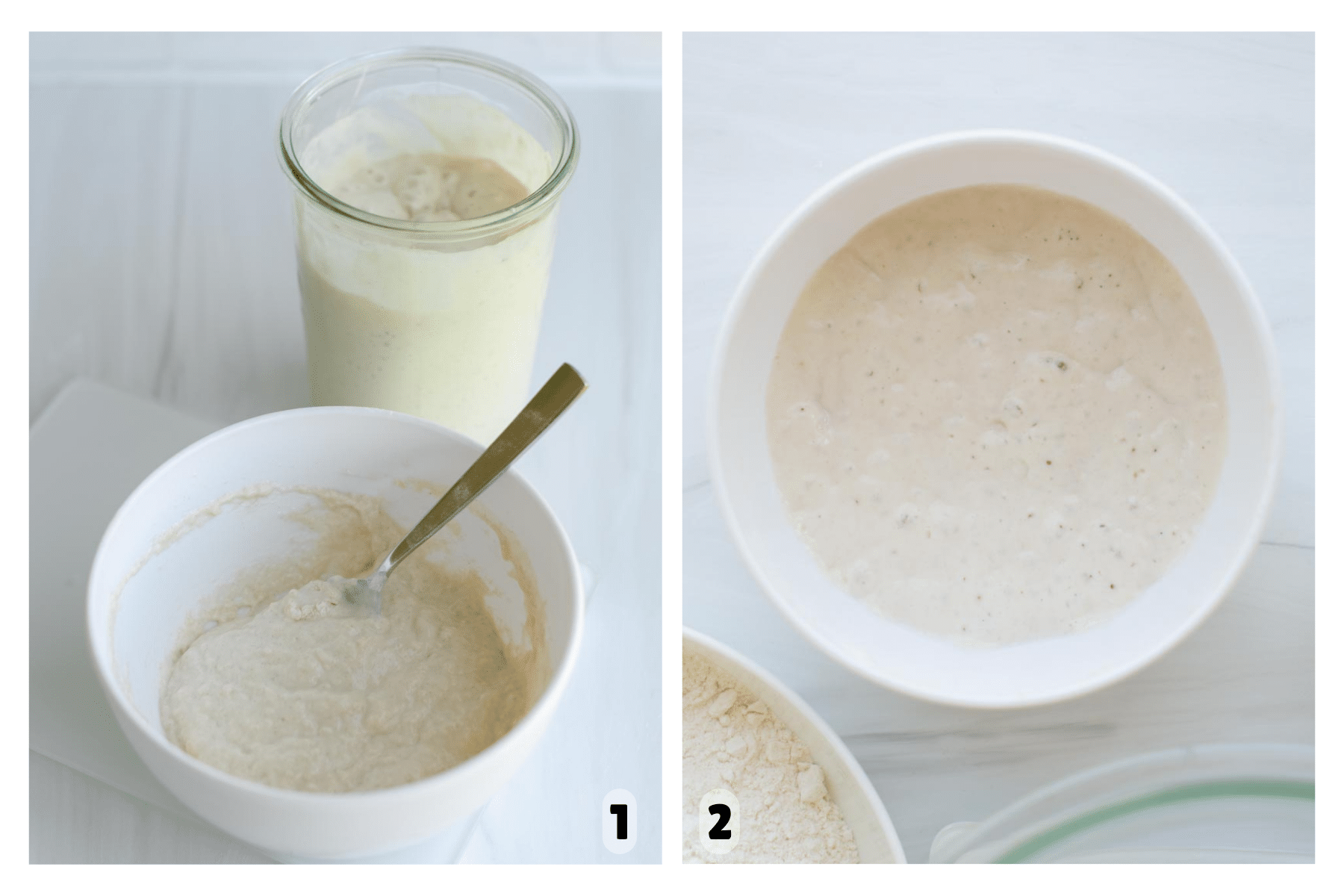
Step 1: Mix Levain. Mix together ripe, active sourdough starter, water, and flour (Image 1). Let rise in a warm place overnight (around 78º Fahrenheit) until peaked, bubbly and active (Image 2).
Can I sub sourdough starter for levain? Yes! You can substitute an active sourdough starter in place of the levain. A levain acts like a boost for your starter and helps ensure it is strong enough to raise the dough, which is why I usually recommend making one. However, if you maintain your starter well and it is active and bubbly, you can use it directly in the recipe. Substitute equal weights starter for levain.
Mix the Dough
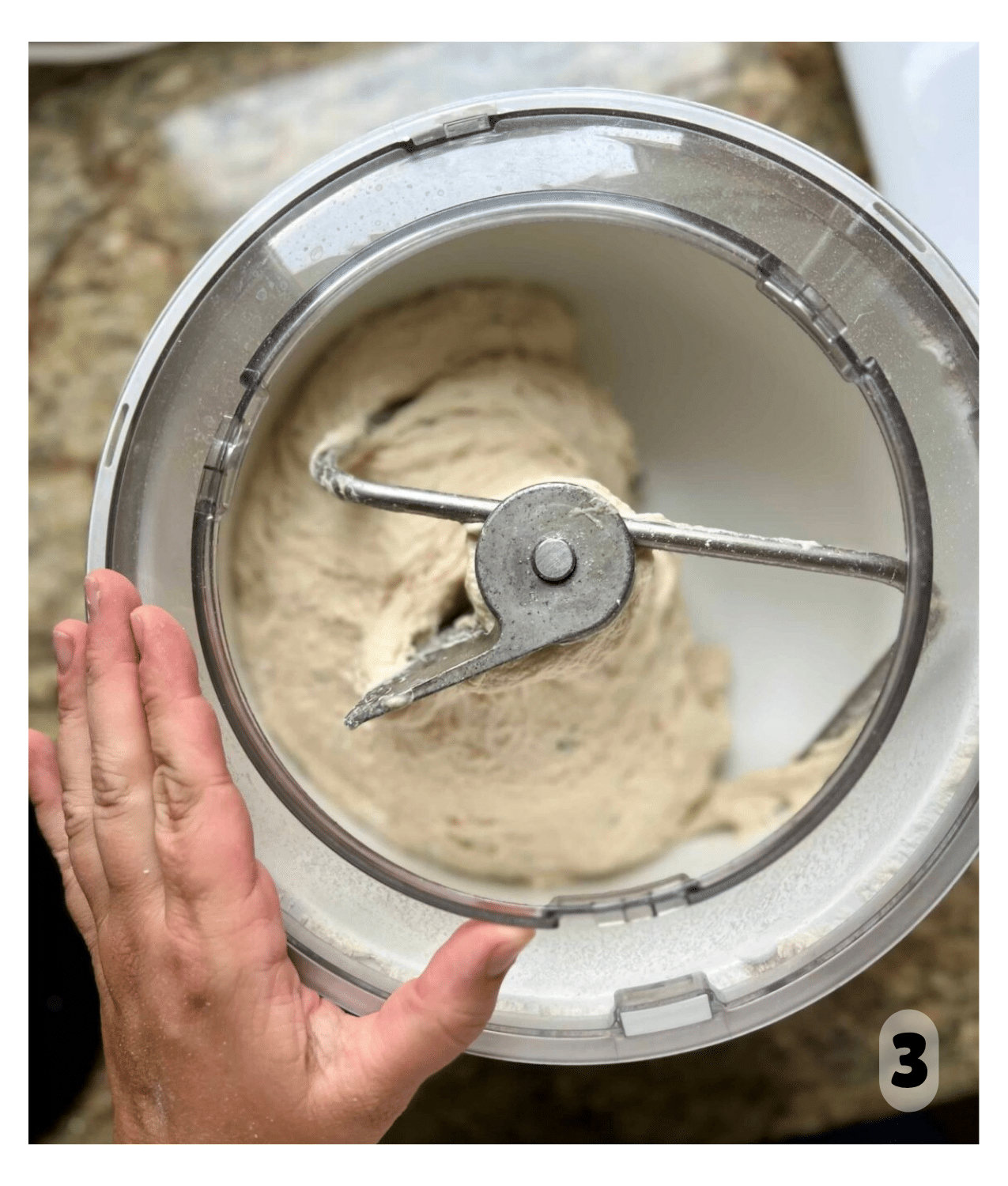
Step 2: Mix Dough. Set the bowl of a stand mixer on a kitchen scale. Warm the milk to around 90ºF. Add the ripe levain, warm milk, warm water, melted butter, sugar and salt to the bowl. Add most of the bread flour, reserving a little bit to add in as you mix. This can help to account for excess liquid or humidity. Start the mixer and knead the dough together for about 8-12 minutes until smooth (Image 3). Add a little extra flour as needed. This dough will be tacky, but not super sticky.
If you don’t have a stand mixer, you can knead this dough by hand for 12-15 minutes until it’s smooth and elastic.
Stand Mixer Tip: Most good quality stand mixers can handle this dough easily (check out my top favorite stand mixers) but keep an eye on your machine while kneading. If the mixer begins to strain or walk on the counter, stop the mixer and finish kneading by hand.
Bulk Fermentation
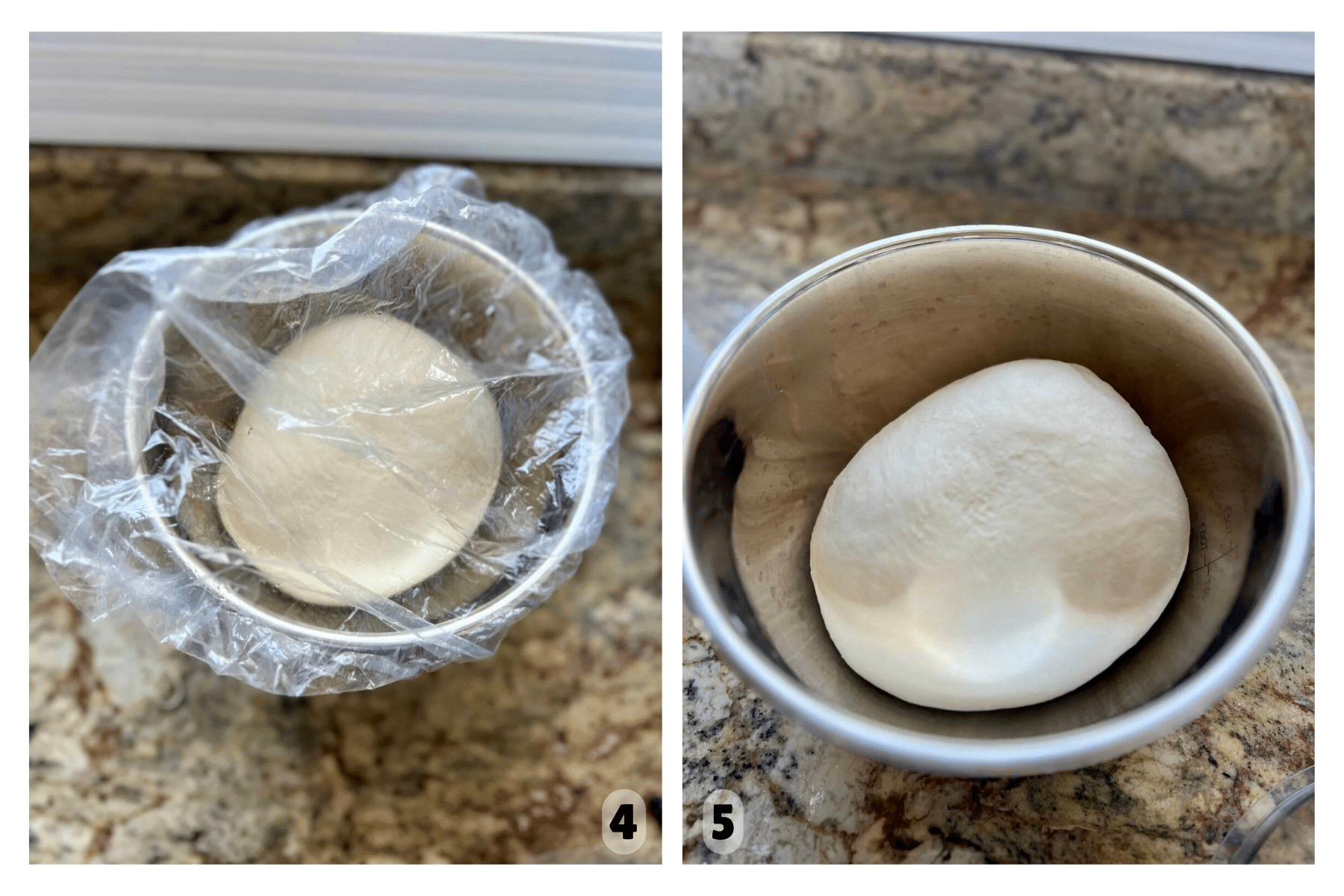
Step 3: Bulk Fermentation. Move the dough to a bowl or container for the bulk fermentation (Image 4). Do your best to keep the temperature of the dough at 78-80ºF over the next 4-5 hours. I use a bread proofer in the winter to help the dough develop at the right temperature.
The entire bulk fermentation will take about 4-5 hours (depending on the temperature of the dough – don’t be scared to stick a thermometer in your dough to check the temperature!). By the end of bulk fermentation, you may notice the dough is more cohesive, strong and aerated. It will have risen about 30% (Image 5).
Cold Fermentation Option: If it is more manageable for you to split this recipe up into multiple days, you can refrigerate the dough after the bulk fermentation. Place the covered dough in the refrigerator for up to 48 hours. Once you shape the English muffins, allow a little extra time for the dough to rise as it comes up to the 78-80ºF dough temperature.
Shaping the Dough
Step 4: Shape English Muffins. Dump the dough on the countertop.Separate into 12 equal pieces, about 90 grams per piece. I weigh my dough and divide the weight by 12 so that I get an accurate amount of dough in each English muffin. This helps the sourdough english muffins all cook at the same rate.
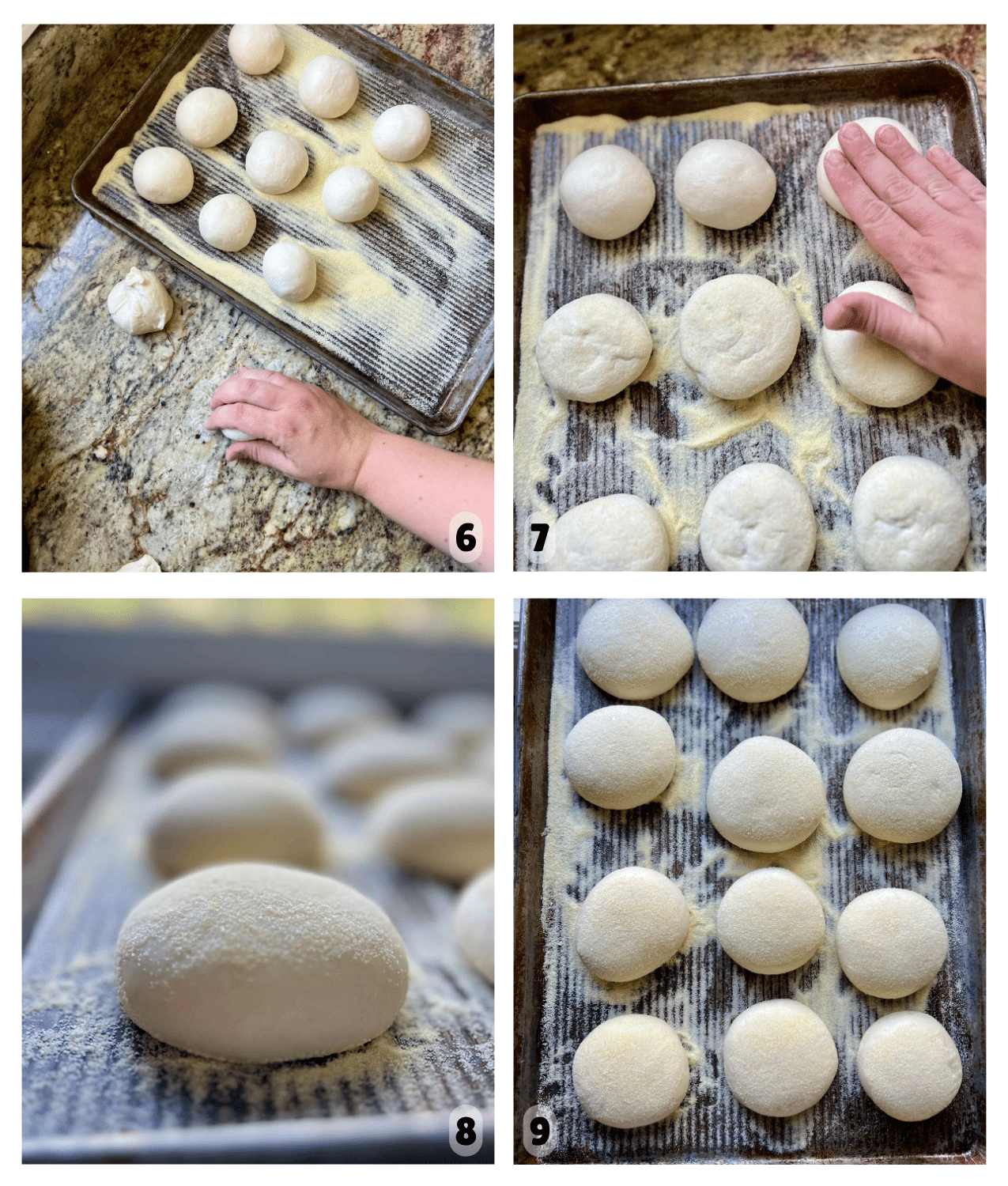
Take each piece of dough and pull/pinch up the sides until it forms a ball. Roll the ball on the counter using your hand in a cupping shape (see video here) to seal the balls and create tension for the English muffins to rise (Image 6).
Prepare a baking sheet by pouring 1/2 cup semolina or cornmeal into a shallow dish (or on the baking sheet) and gently press each ball of dough into the semolina (Image 7). You can also line your baking sheet with parchment paper if desired. Flip the ball over and repeat on the other side, pressing into the semolina. Both sides will be covered and the dough will be flattened a little through this process.
Place the dough on the baking sheet. Repeat with remaining dough balls. All 12 English muffins should fit on the baking sheet. Take your hand and lightly press down on each English muffin, giving a flatter shape (Images 8 & 9).
Proof the English Muffins
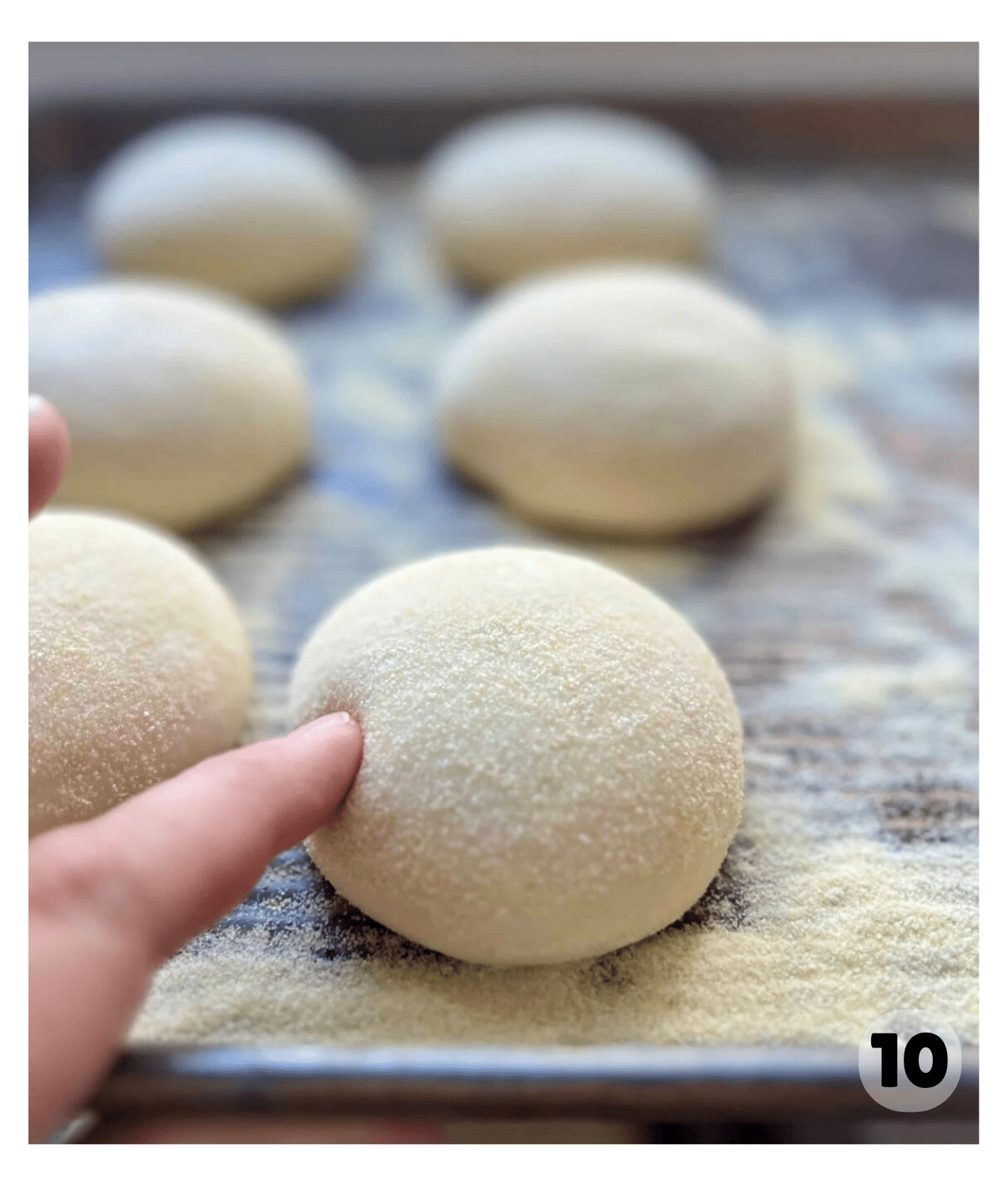
Step 5: Proof. Cover the sourdough English muffins with a baking sheet or plastic wrap and let them proof (rise) in a warm, 80ºF place. I like to place mine in my oven with the light on (don’t turn the oven on) or on a dough mat for warmth. Typically, sourdough English muffins kept at this temperature take about 3-4 hours to fully proof. Do not bake these english muffins if they have not risen. Take your finger and press into one of the muffins. If the dough springs back just a little bit, they are ready to bake (Image 10).
Amy’s Tip: My biggest tip with sourdough bakes is to let them rise enough before cooking or baking. For these English muffins, you want them to puff up and almost double in size before moving to the pan. If they are not rising, warm them up.
Cook and Bake the English Muffins
Step 6: Pan Fry and Bake. Traditionally, English muffins are cooked in a pan on the stovetop. In this recipe, we use two cooking methods. First, cook the muffins in a pan or cast iron skillet to create the classic golden tops and bottoms. Then finish baking them in the oven so they cook all the way through.
If the muffins were cooked on the stovetop the entire time, the bottoms would likely burn before the centers were fully baked. Finishing them in the oven helps them bake evenly while keeping that classic English muffin texture.
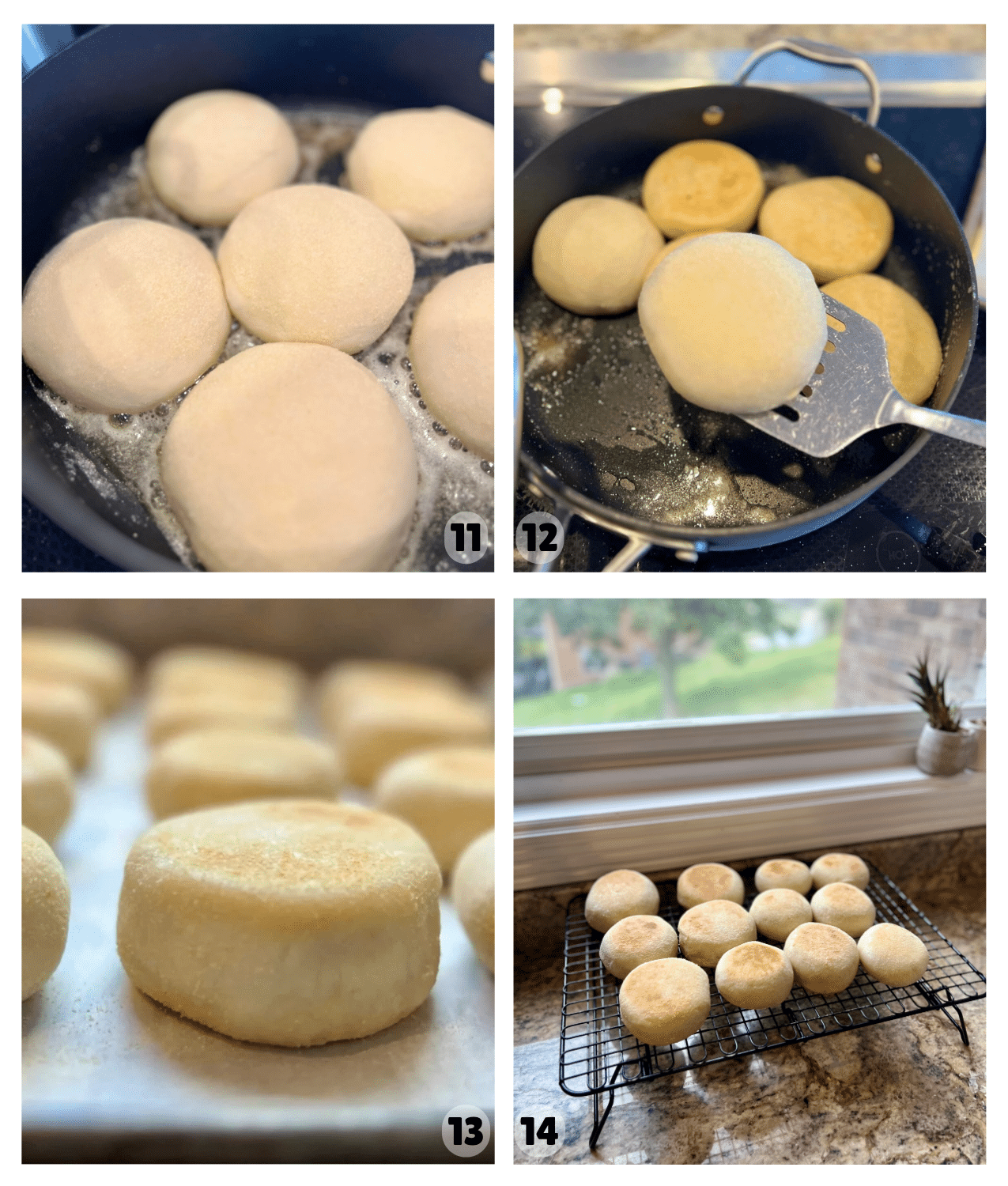
Pan Fry: Preheat the oven to 350ºF and prepare a skillet over medium-low heat, coating it with a Tablespoon of butter. The butter is technically optional, but I love the crisp crust it gives the english muffins. Gently place the English muffins into the pan, cooking for about 2-3 minutes per side before flipping and baking on the other side (Images 11 & 12). The outside of the English muffins will bake, leaving the inside still doughy and raw.
Oven Bake: Put the half-baked English muffins on the parchment-lined baking sheet (Image 13). Repeat this process until all the English muffins have been skillet-cooked. Place the pan of English muffins in the oven and bake for about 12-15 minutes until baked all the way through and reach an internal temperature of 205-210ºF. Remove from the oven and let cool on a cooling rack (Image 14). Enjoy!
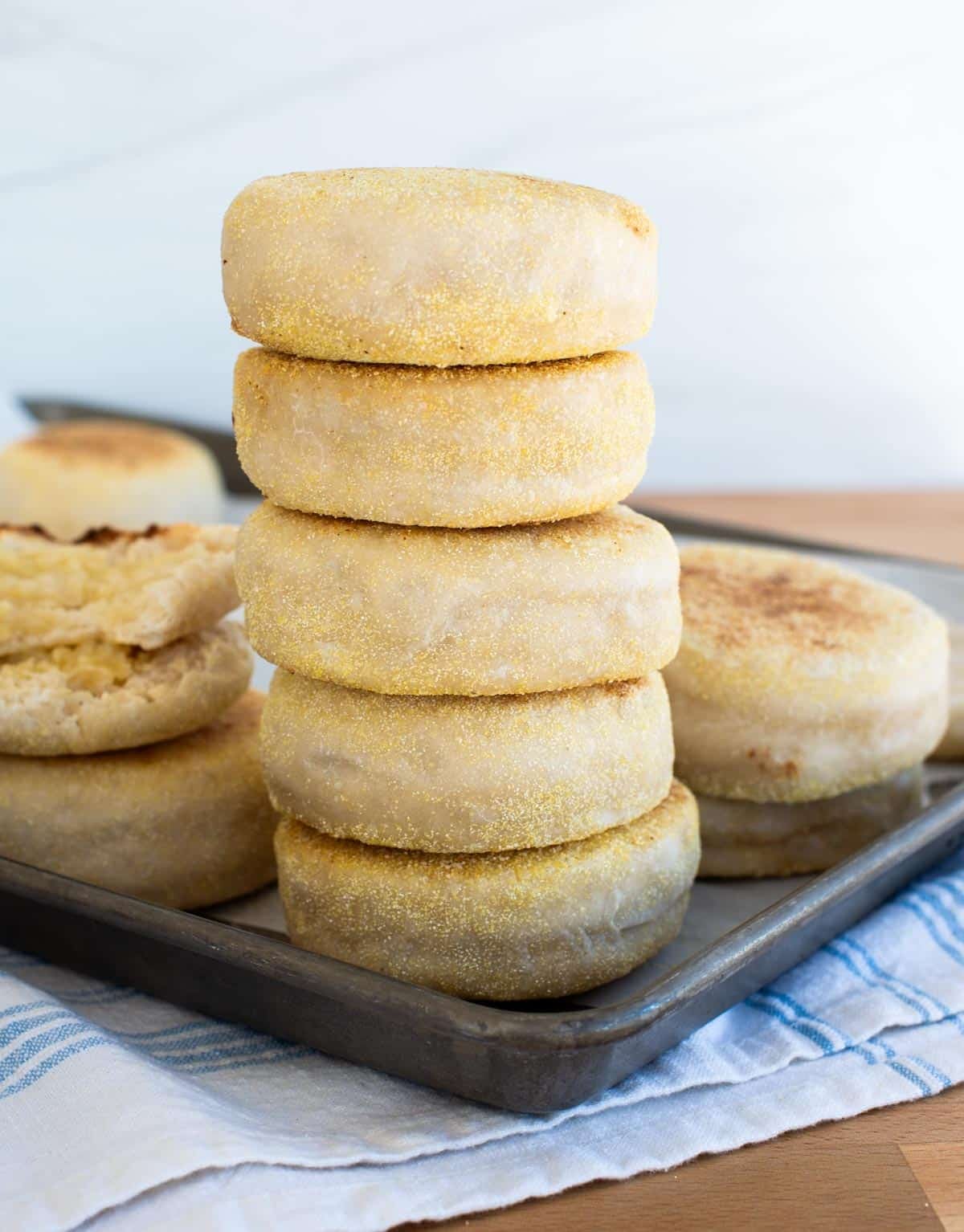
Amy’s Recipe Tip: Whatever you do, don’t use a knife to slice your English muffins. A knife cuts through the delicate air pockets and seals them shut. Instead, use a fork to poke around the center of the muffin and gently pull it apart. This keeps those signature nooks and crannies intact so they can catch all that melted butter.
How to Store Leftovers
I like to make these ahead and freeze them for easy breakfasts. Once the English muffins have cooled, place them in an airtight container or zip-top bag and freeze for up to 3 months. When you’re ready to eat one, pull it out and let it thaw at room temperature or warm it in the microwave for about 10 seconds. Then split it open and toast.
How to Get Perfect Sourdough Nooks and Crannies
How do you get the nooks and crannies? If you’re after those classic nooks and crannies, the best thing you can do is let the English muffins rise until they are almost doubled in size before cooking. That rise creates the air pockets that turn into those little holes. After they cool, split them open with a fork rather than a knife. When toasted, those pockets open up even more and you’ll see all those beautiful nooks and crannies.
Frequently Asked Questions
You can. You’ll want to use a medium-low heat and adjust as needed. The English muffins tend to burn if baked completely in a pan. Bake for about 5-7 minutes per side until completely baked through.
For this recipe you will want an active, bubbly starter to help the muffins rise properly. Discard does not have enough strength on its own to give the muffins their light texture. If you want a discard english muffin recipe, try my no mixer discard english muffins.
We serve our english muffins with homemade jam, softened butter, cream cheese, a fried egg and even make little pizzas out of them for a quick dinner.
If your muffins didn’t puff up, the dough likely needed more time to rise. Sourdough baking depends on an active starter and proper fermentation. Make sure your dough is in a warm environment and allow the muffins to rise until they look noticeably puffy before cooking.

Popular Sourdough Breakfast Recipes



If you tried these Sourdough English Muffins or any other recipe on my website leave a 🌟 star rating and let me know how it went in the comments below. Happy Baking!

Sourdough English Muffins
Save this for later!
Equipment
- skillet
Ingredients
Levain (1:10:10, 10-12 hours/overnight at 78 degrees F)
- 6 grams sourdough starter, ripe/bubbly/active, about 1 teaspoon
- 60 grams all-purpose or bread flour, scant 1/2 cup
- 60 grams water, about 1/4 cup
Sourdough English Muffins
- 115 grams levain, ripe/active/bubbly, see recipe notes, about 1/2 cup
- 55 grams milk, whole or 2% works best, warmed to around 90 degrees F, about 1/4 cup
- 275 grams water, about 1 cup plus 2 Tablespoons
- 30 grams unsalted butter, melted and cooled, about 2 Tablespoons
- 10 grams granulated sugar, about 2 teaspoons
- 12 grams salt, about 2 teaspoons
- 600 grams bread flour, about 4-5 cups
- semolina or cornmeal for rising/dusting
- 30 grams unsalted butter, for cooking, about 2 Tablespoons
Instructions
Levain (1:10:10, ready in 10-12 hours at 78 degrees F)
- Mix together 6 grams of ripe/bubbly/active sourdough starter with 60 grams all-purpose flour and 60 grams water. Cover and keep levain at 78 degrees Fahrenheit for 10-12 hours until bubbly, active and ripe.
Sourdough English Muffins
- To the bowl of a stand mixer, mix together the ripe levain, milk, water, melted butter, sugar, salt and bread flour. Mix until completely combined and the dough feels tacky (not super sticky) and pulls away from the sides of the bowl. I like to reserve about 70 grams of bread flour (about 1/2 cup) and add it in as the dough kneads together, making sure that I'm not adding too much flour to the dough.
- Knead together for 8-10 minutes, adding the rest of the flour as needed, until the dough is soft and smooth. The dough should be tacky to the touch, not overly sticky. If it is very sticky, add a little bit more flour, about 20-30 grams at a time.
- Bulk Fermentation: Put the dough in a container and cover. Set the dough in a warm, 78-80 degree F place for 4-5 hours. Take the temperature of the dough as needed to maintain the dough temperature right around 78-80ºF (I use this bread proofer to keep my dough temperature consistent).
- At the end of about 4 hours, the dough should be puffed up and feel very elastic. It will not double in size. If it doesn't feel this way, let it bulk ferment for another half hour and check again
- Overnight Option: At this point, after the bulk fermentation has finished, you can cover the dough and put it in the refrigerator for 24-48 hours. Proceed with the recipe the next day, shaping and proofing the bread before baking. Add a little extra time for the loaf to rise to account for the temperature change.
- Shaping English Muffins: Dump the dough onto a countertop. Cut into 12 equal sized pieces. Take each piece of dough and pull/pinch up the sides until it forms a ball. Roll the ball on the counter using your hand in a cupping shape (see video here) to seal the balls and create tension for the English muffins to rise. Prepare a parchment-lined baking sheet. Pour 1/2 cup semolina or cornmeal into a shallow dish and gently press each ball of dough into the cornmeal/semolina, flipping it over so both sides are lightly covered. Place the dough on the parchment-lined baking sheet. Repeat with remaining dough balls. All 12 English muffins should fit on the baking sheet. Take your hand and lightly press down on each English muffin, giving a flatter shape.
- Proofing: Cover the pan and let the English muffins rise in an 80ºF place until puffed up and risen, about 3-4 hours. Do not bake these English muffins if they have not risen. Take your finger and press gently into one of the English muffins. If the dough springs back just a little bit, they are ready to bake.
- Pan Fry and Bake: Pre-heat the oven to 350ºF. Prepare a skillet over medium-low heat, coating it with a Tablespoon of butter. Gently place the English muffins into the pan, cooking for about 2-3 minutes per side before flipping and baking on the other side. The outside of the English muffins will bake, leaving the inside doughy and raw. Put the English muffins on the parchment-lined baking sheet. Add a little more butter to the pan and repeat this process until all the English muffins have been skillet-cooked. Place the pan of English muffins in the oven and bake for about 12-15 minutes until baked all the way through and register 205-210ºF. Let cool and completely. When ready to eat, use a fork to poke around the center of the English muffin and gently pull it apart. Toast for those beautiful nooks and crannies and enjoy!
Notes
Nutrition
Nutrition information is automatically calculated, so should only be used as an approximation.


Just finished eating my first one of my first batch. Pretty yummy! No nooks and crannies, but maybe next time! Thanks for the well-explained recipe!
Thanks for sharing your review!
can heavy cream be used instead of milk?
They might turn out a bit denser, but it should still turn out well!
Hi! I followed the recipe until after a cold proofing, but I had to sit it out and was not able to shape until after about 2 1/2 hours. After shaping and I let it rest another 2 1/2 hours. I did the poke test and it rose pretty quickly.
Yet, when I followed the rest of the directions and let it cool, the center of some of them was more gummy than others.
Do you have any advice for how to prevent this, as I followed some of the other recipes on their website, and the only one that doesn’t come out gummy is the sourdough soft sandwich bread?
It sounds like they needed to bake a bit longer. Do you have a thermometer to check the internal temperature prior to removing from the oven? I’d recommend making sure the internal temp reaches 205-210ºF.
Will these toast? I can’t get any of my sourdough bread to toast. Thank you
Yes, they should toast nicely! If your sourdough isn’t toasting well, it’s often because the bread is still a bit moist inside. Letting it sit a day before toasting usually helps. You can also try toasting it a little longer or letting the bread sit out overnight before slicing and toasting.
I put the dough in the fridge last night. should I let it come to room temp before shaping or go ahead & shape right out of the fridge?
I would shape them right out of the fridge and then let them come to room temp as they proof, adding a bit of extra time to the proofing.
I’ve made these multiple times. I substitute honey for sugar. They are excellent.
Thanks for sharing!
Hey Amy, Do you know how much each ball of dough should weigh in grams? I’m terrible at cutting them into equal balls unless I’m measuring.
I haven’t weighed them out myself, but looking at the weights in the recipe, I ‘d estimate each ball of dough should be roughly 90 grams. You could also just weigh all of your dough and divide that weight by the number of English muffins you want (this recipe calls for 12) and then shape and weigh from there in order to be more precise. Happy baking!
Great recipe, just made it this morning again. Mine weighed 83 grams each, 12 muffins.
Thanks for sharing!
I make mine 80-85 grams and they are perfect size.
Thanks for sharing!