How to Dehydrate and Rehydrate Sourdough Starter

Updated Feb 18, 2025
Affiliate disclosure: This post may contain affiliate links. Please see our disclosure policy.
Looking for a way to save your sourdough starter? Or maybe you just purchased or were gifted some dehydrated starter and want to rehydrate it? This guide will walk you through how to dehydrate and rehydrate sourdough starter.
Get your FREE PDF Guide to Rehydrating a Sourdough Starter – HERE

Save this for later!
Why I Dehydrate Sourdough Starter
I like to dehydrate my starter so I always have a long-term backup in case anything were to happen to my sourdough starter. If you’ve made a sourdough starter from scratch, you know the labor of love it is! There’s no way I want to chance losing my starter, so dehydrating some starter to save as a backup is important. I also love gifting dehydrated sourdough starter to friends who want to start their sourdough journey. It’s the gift that keeps on giving.
How to Dehydrate Sourdough Starter
1. Feed Your Starter
If you have been feeding your starter at room temperature daily:
Feed it like normal and wait until the starter doubles in size and is very bubbly and ripe.
If you have been feeding your starter weekly in the fridge:
Feed your starter like normal and let it rise until doubled and bubbly. At that point, I like to take some of the starter and feed it again so I have a very active starter that I’m dehydrating.
2. Line a baking sheet with parchment paper
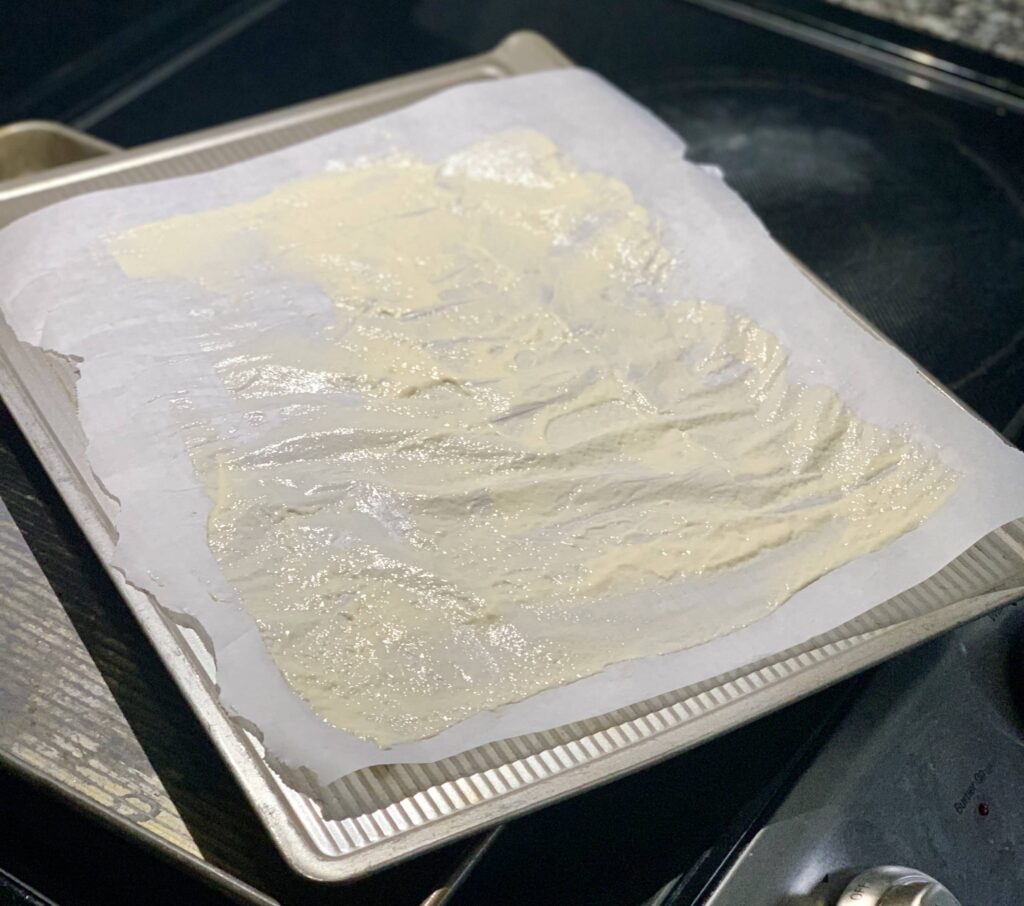
Use an offset spatula to spread the bubbly sourdough starter very thinly onto the piece of parchment paper.
3. Let the starter air dry or dehydrate in a dehydrator
Air dry: Allow the starter to air dry for 24-48 hours. You can try turning placing the starter in the oven with the light on (make sure the oven is turned OFF) to speed up this process. Let the starter dry out completely.
Dehydrator: Turn the dehydrator to a very low setting (80-90ºF range is best). Be careful not to get over 100-120ºF as that can lead to reduced activity and your starter dying off. Let the starter dehydrate for a few hours or up to overnight until completely dry.

4. Break up the dried-out starter
Once the starter is completely dry, break it up into little pieces or give it a quick whirl in the blender if you want it broken down into little pieces. Place in an airtight container. Store in a dark, cool place for many months or up to a few years.


What to do with Dehydrated Sourdough Starter
Once your starter is dehydrated and stored, go ahead and gift some. Keep some in your pantry so you have a true backup starter. Once you are ready to bake with your starter again, start the re-hydration process. This typically takes about 2-3 days to get your starter nice and bubbly. Remember, this process is also dependent on temperature, climate and activity of your sourdough starter when it was dehydrated.
How to Rehydrate Sourdough Starter
Note: You can rehydrate a starter using many methods, amounts of water or even just “eye-balling” it. This guide is not intended to be the one and only way to rehydrate a starter. It is to help give you a method to follow that will get your dehydrated starter active and ready to use in a couple of days.
Gather Supplies
- Kitchen Scale: For best results, use a kitchen scale with metric units (grams).
- Flour: All-purpose OR Bread flour OR a combination of white flour with rye/whole wheat if you want to see activity more quickly.
- Water: Tap water is fine as long as you don’t have chlorine/chloramine in your water. If you aren’t sure, use bottled water.
- Clear Jar: I like a 16 oz mason jar.
- Thermometer: Optional, but helps to know the temperature of your starter and if you will need to warm it up.
- Spatula: I love this little spatula for stirring, but any spatula works well.
- Rubber Band: Use a rubber band to mark the jar so you can see the rise.
- Dehydrated Starter: The one you made yourself or acquired from someone else.
Day 1
Place a clean jar on the kitchen scale. Add 10 grams dehydrated sourdough starter to the jar. Add 50 grams warm water and place the lid on the jar. Shake it. Keep the jar in a warm place and shake the jar, breaking up the sourdough starter and dissolving it in the water over 3-4 hours. The starter will be milky white.
Once dissolved, place the jar on the scale. Add 50 grams flour to the jar. Stir together. Add 5-10 more grams water to the jar until a thick batter forms. Cover the jar with a loose fitting lid. Mark the jar with a rubber band. Keep in a 78ºF place overnight or until doubled in size.


Day 2
Morning: Check on the starter. Look for bubbles, activity and any smell difference you notice. It may or may not have done much overnight. Take 50 grams of the starter. Add it to a clean jar and feed it 50 grams flour (include whole wheat and rye in this feeding if you aren’t noticing much activity yet) and 50 grams water. Stir together, cover and mark the jar. Set in a warm 78ºF place for about 12 hours.
Evening: Note how the starter looks. If it’s bubbly and doubled in size and peaked with a milky/mild aroma, it is ready to use to make bread. If it’s not there yet, it’s okay. Repeat the discarding and feeding process.


Day 3
Morning: Repeat the steps from Day 2.
Evening: Repeat the feeding process if needed. Continue with this feeding process until your starter is active and ready to use.
Starter is ready to use when it has doubled in size, is peaking, active, smells mild/milky sweet and has bubbles throughout.

Dehydrated Starter is Ready to Use Again
Once your starter is rising and falling predictably, it is ready to use! Location, ambient temperature, health/activity level of the dehydrated starter and environment will determine how quickly the process of rehydrating a starter goes. Typically the process takes about 48-72 hours if kept warm. Use a whole wheat or rye flour to speed the process up a bit.
If you are new to the process of sourdough START HERE. If you’ve baked sourdough before, try some of my favorite beginner recipes that are easy to use with an active, bubbly and ripe newly-rehydrated sourdough starter:
Sourdough Beginner Guide
 What is Sourdough?
 How to Make a Sourdough Starter
 How to Feed and Maintain a Sourdough Starter
 When Is Sourdough Starter Ready to Use? Easy Signs to Look For
 What is Sourdough Discard?
 How and Why to Make Levain
 Sourdough Timeline for Beginners: How To Fit It Into Your Day
 How Temperature Affects Sourdough
 Sourdough Starter Ratios Explained
 Essential Tools for Baking with SourdoughSourdough Frequently Asked Questions
 How to Dehydrate and Rehydrate Sourdough Starter
 How to Add Sourdough Discard to Any Recipe
 How to Replace Yeast with Sourdough Starter
 Adjusting the Sour Flavor in Sourdough Bread
 Sourdough Artisan Bread Guide
 How to Bake Sourdough in A Loaf Pan
 Adding Inclusions to Sourdough Artisan Bread
Need More Help? Take a Sourdough Class with Amy Bakes Bread


Hi Amy, my name is Deb Gray and I just received your book! Can’t wait to dive into it. My question is I have already purchased a San Francisco dehydrated sourdough starter and the gram packet is 5.4g. How would I modify the instructions in your book which calls for 10g of starter?
Appreciate any assistance. Best regards, Deb.
The most important thing is keeping the ratio the same. So if you’re using 5 grams of starter, just cut the flour and water in half as well to match the ratio in the 10 gram instructions. Hope that makes sense!
This is awesome… thank you so much for sharing.
Glad it’s helpful for you!
I dehydrated my starter (was active and bubbly) for a cross-country move. When I dehydrated it, I did not know I was supposed to use the starter when it was at peak and ripe, active and bubbly; instead I dehydrated after the starter had peaked and fallen in the jar. I’ve tried rehydrating it once using instructions from abeautifulplate.com. Although it consistently doubled and tripled, it was never very bubbly. I started over yesterday using your method. Not much activity overnight. This morning I fed 1:1:1 (50g starter, 10g rye flour, 40g all purpose, 50g water). My question is: Is my dehydrated starter the problem because I didn’t use peak, ripe, and bubbly starter? Should I just try to get some starter from a local baker or online? Thank you in advance for your help!
I would give it another day or two to see if it can come back. I don’t think dehydrating your starter past peak would make too much of a difference in how it comes back. If you had dehydrated it before it had peaked – then that may have been an issue.
I am doing this today and my stony goes as low as 90. I am hoping I don’t kill it! Thoughts? Thanks!!😊
I would just put it on the lowest setting and check on it throughout the day – it can go pretty fast in a dehydrator.
To rehydrate dehydrated starter, let’s say you start with 10g dehydrated starter. How much water do you start with in 1st hour? You noted a 1/4 cup of flour, which seems like 1:20:20 ratio. Thank you!
I usually do equal weights of flour and water now. I’m planning to update this post soon with a more clear method. 1/4 cup flour is about 30-35 grams of flour so I would use 30-35 grams of water added to the dehydrated starter and then add in the flour. It’s about a 1:3:3 or 1:4:4 ratio.
I have made dehydrated starter flakes to share later. I have stored in cotton cloth but you say airtight container. Does it matter. I don’t want it to mold.
So grateful for your website. I am sharing It with other beginners🥰
I prefer storing in an air-tight container to keep it from molding and any critters. I haven’t tried it in a cotton cloth, so I’m not sure.
We are grateful to be the well-fed beneficiaries of your rehydrated sourdough starter!! Thank you for bringing it across the miles and sharing all that deliciousness with us!! ❤️🍞🥖🥐🥞🧇😋