
Affiliate disclosure: This post may contain affiliate links. Please see our disclosure policy.
If you love a rustic, artisan loaf of Classic Sourdough Bread, you’re going to love these Mini Sourdough Loaves. They have that same crisp crust, soft crumb, and classic sourdough flavor, just in a smaller, giftable size. In this article, I’ll show you exactly how to make mini sourdough loaves, step by step, whether you’re baking them in mini loaf tins or shaping them into small boules to bake in a Dutch oven. Mini sourdough loaves also bake more quickly, usually 30–35 minutes total, which makes them perfect for weeknight baking or gifting.
Mini sourdough loaves are also perfect for mixing and matching flavors, almost like a little “sourdough flight.” Keep them simple or add cheese, herbs, dried fruit, or chocolate chips. However you make them, these mini loaves are a thoughtful homemade gift and such a delicious addition to any holiday table.

Save this for later!
Table of Contents
- Why You’ll Love Mini Sourdough Loaves
- Important Ingredients
- Substitutions
- My Favorite Tools for Gifting Mini Sourdough Loaves
- Sourdough Baker’s Timeline
- How to Make Mini Sourdough Loaves (Step-by-Step)
- How to Store Leftovers
- Amy’s Recipe Tips
- Frequently Asked Questions
- Sourdough Favorites
- How to Make Mini Sourdough Loaves Recipe
Why You’ll Love Mini Sourdough Loaves
Mini sourdough loaves are smaller versions of a classic sourdough loaf, usually around 300 grams each. They bake faster, are easier to customize with mix-ins, and are the perfect size for gifting. You can bake mini sourdough loaves in mini loaf pans or as small boules in a Dutch oven. You’ll love them because…
- Amazing taste in a small package – These mini loaves, made with wild yeast sourdough, bake up with that crispy crust and soft, airy interior we all love. They have the same artisan flavor as a classic sourdough loaf, just in a smaller, faster-baking version.
- Perfect for gifting (and flavor mixing!) – Mini loaves make the sweetest homemade gifts, and they’re fun to customize. Add herbs, cheese, nuts, or dried fruit, or divide the dough to try a few different mix-ins with one recipe. Stick your loaves into these gift bags that make giving the gift of sourdough so easy!
- Flexible and beginner-friendly – Make them in mini loaf pans, a Dutch oven, or even shape them free-form. I’ve even used this dough and a similar process to make my sourdough bread bowls. And if you’d rather bake one big loaf instead, this dough works beautifully for that too!
New to Sourdough? If you are new to sourdough, learn how to make a sourdough starter from scratch and check out my Free Sourdough Beginner Guide. Using naturally fermented sourdough will take much longer, but you will love the fermentation benefits and the flavor!
Important Ingredients
- Levain – This recipe uses the French style of sourdough (levain) that acts as a power feed for your sourdough starter. It’s not hard, just an extra feeding step to give you the best bread. If you don’t have a sourdough starter, first make your own, get some from a friend, or purchase one.
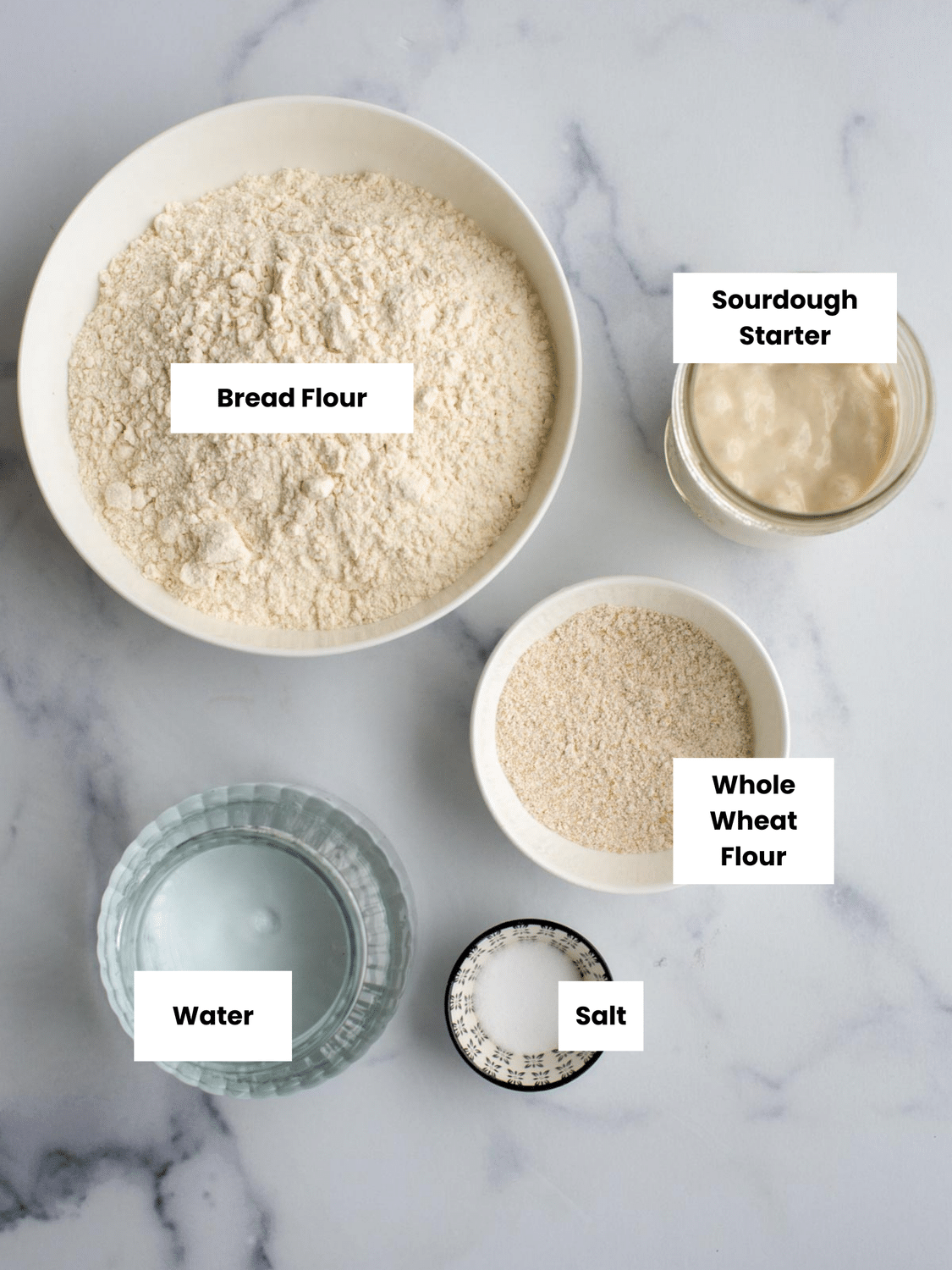
- Bread Flour – Use good-quality bread flour with 12-12.5% protein content.
- Whole Wheat Flour – Whole wheat flour gives a boost to the fermentation of the dough and adds good flavor to this bread. I like to freshly mill my whole wheat, but aged whole wheat flour from the grocery store works well, too.
- Water – Use warm water to warm up your dough or cool water to cool it down so it can stay in the 76-78ºF temperature range.
- Salt – I use table salt.
See the recipe card for full information on ingredients and quantities
Substitutions
There’s not much in the way of substitutions when you are working with only a few ingredients!
- Sourdough Starter: Skip the levain and substitute ripe, active sourdough starter that is 100% hydration (starter that has been fed equal weights of flour and water).
- All-Purpose Flour: I like the chewy, fluffy crumb bread flour produces, but all-purpose flour can work as well. Decrease the water by about 25 grams if you are going to use all-purpose flour, or the dough can be more difficult to work with.
- Whole Wheat Flour: You can substitute bread flour for the whole wheat flour in this recipe. Note that the dough will take a little bit longer to rise and ferment if you don’t use whole wheat flour.
- Mix-Ins: This dough is the perfect base for adding flavor inclusions. For loaves that are all the same, add nuts, dried fruit, cheese, or other mix-ins during the second stretch and fold. For a sourdough “flight” with different flavors, wait and add the inclusions right before shaping. For cinnamon sugar, add it at shaping so it doesn’t interfere with the gluten structure.
- Levain Ratio: The ratios of flour, water, and starter can be adjusted so that your levain will double in the timeframe that works for you. If you want to mix your levain in the morning, mix together 70 grams of ripe/over-ripe starter with 70 grams of flour and 70 grams of water. IF kept at a warm 78ºF temperature, the levain will be doubled in 3-4 hours. If your temperature is colder, the process will take longer.
My Favorite Tools for Gifting Mini Sourdough Loaves
Mini sourdough loaves are perfect for gifting, especially around the holidays, for neighbor gifts, or anytime you want to share something homemade. They look adorable, bake up beautifully, and feel extra special without a lot of extra work.
If you want inspiration on how I often gift my sourdough bread, be sure to check out my full guide: How to Gift Sourdough. And if you want gift ideas for the sourdough lovers in your life, don’t miss my Gift Guide for Sourdough Bakers.
Here are some of my favorite tools and supplies for gifting mini loaves:
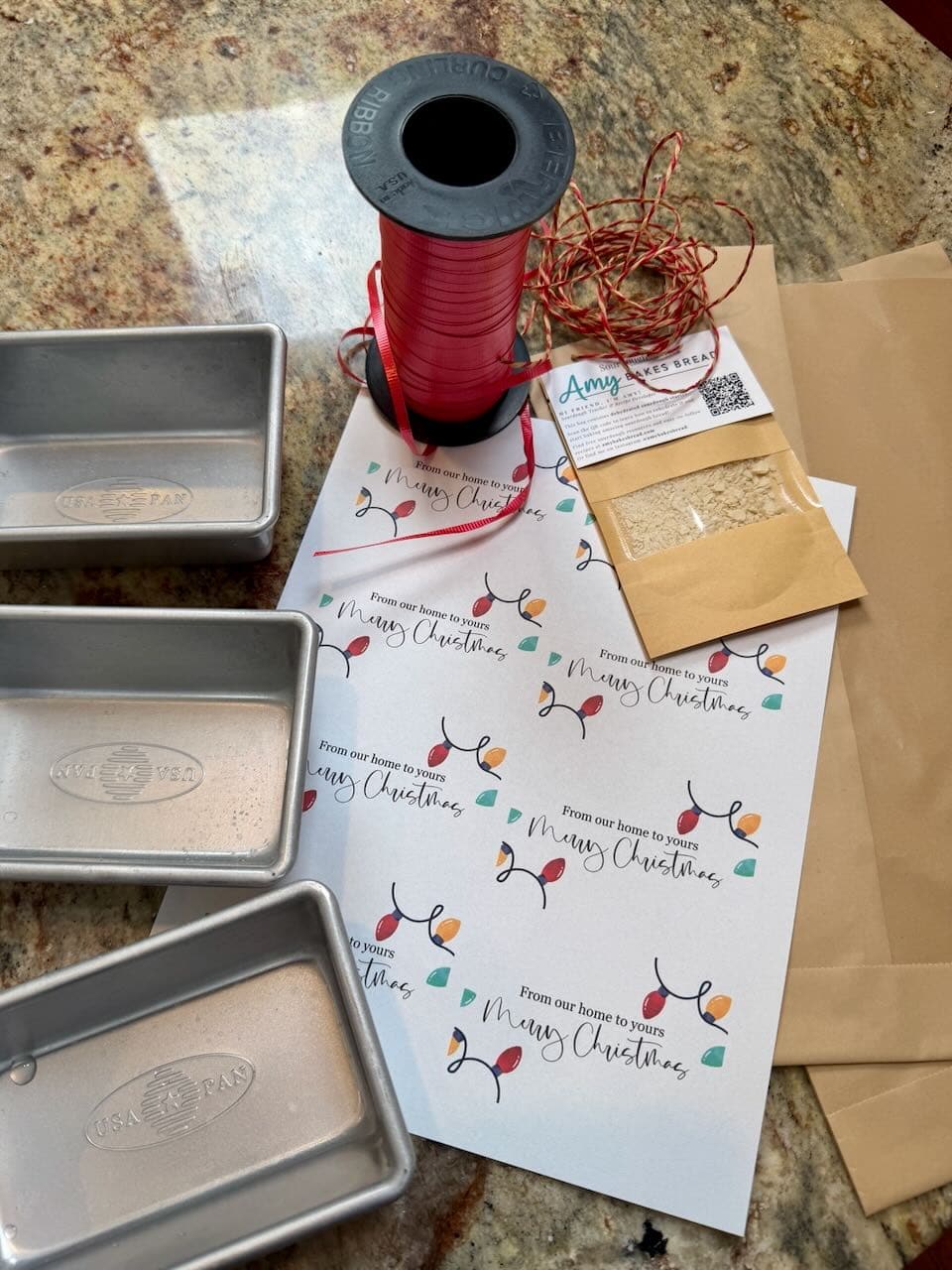
- Bread Bags – I always keep a stash of these on hand for gifting loaves. They make everything look polished with zero effort.
- Labels or Gift Tags – Grab my free printable gift labels! You can print them on sticky labels or regular paper to tie onto your bags.
- Mini Loaf Pans – These are my go-to pans for baking mini loaves. They bake evenly and make the cutest gift-sized breads.
- Small Bannetons – Perfect for shaping mini loaves. And if you don’t have one? Don’t worry. Cereal bowls or any small bowls you have at home work just as well.
- Ribbon or Baker’s Twine – Totally optional, but I love adding a simple ribbon or twine when I want the loaves to feel a little extra special.
Sourdough Baker’s Timeline
Because sourdough takes time to rise, I include sourdough sample schedules in my sourdough recipes. These schedules are not meant to be followed exactly but rather give you an idea of a timeline, which is very dependent on the temperature of your dough/starter and the activity of your starter.
Note: The schedule assumes a dough temperature of 76-80ºF. I hope it’s helpful to you.
| Day 1 | Mix Levain |
| 9:00 PM – 9:00 AM | Mix Levain Let Rise Overnight at 78ºF Note: Ripe, bubbly, active sourdough starter can be substituted for levain |
| Day 2 | Mix Dough/Bulk Fermentation/Folds/Shape/Cold Fermentation |
| 9:00 AM – 9:30 AM | Fermentolyse (mix flour, water, levain) |
| 9:30 AM – 10:00 AM | Add Salt and Reserved Water Mix Dough and Rest |
| 10:00 AM | Stretch and Fold #1 |
| 10:30 AM | Stretch and Fold #2 |
| 11:00 AM | Stretch and Fold #3 |
| 11:30 AM | Stretch and Fold #4 (if needed) |
| 11:30 AM – 1:00 PM | Rest and complete bulk fermentation at 78ºF |
| 1:00 PM | Divide, Pre-shape and Rest |
| 1:30 PM | Shape and begin Cold Fermentation |
| Day 3 | Bake |
| 8:30 AM | Preheat Dutch oven (if using) |
| 9:00 AM | Bake |
How to Make Mini Sourdough Loaves (Step-by-Step)
Mix the Levain
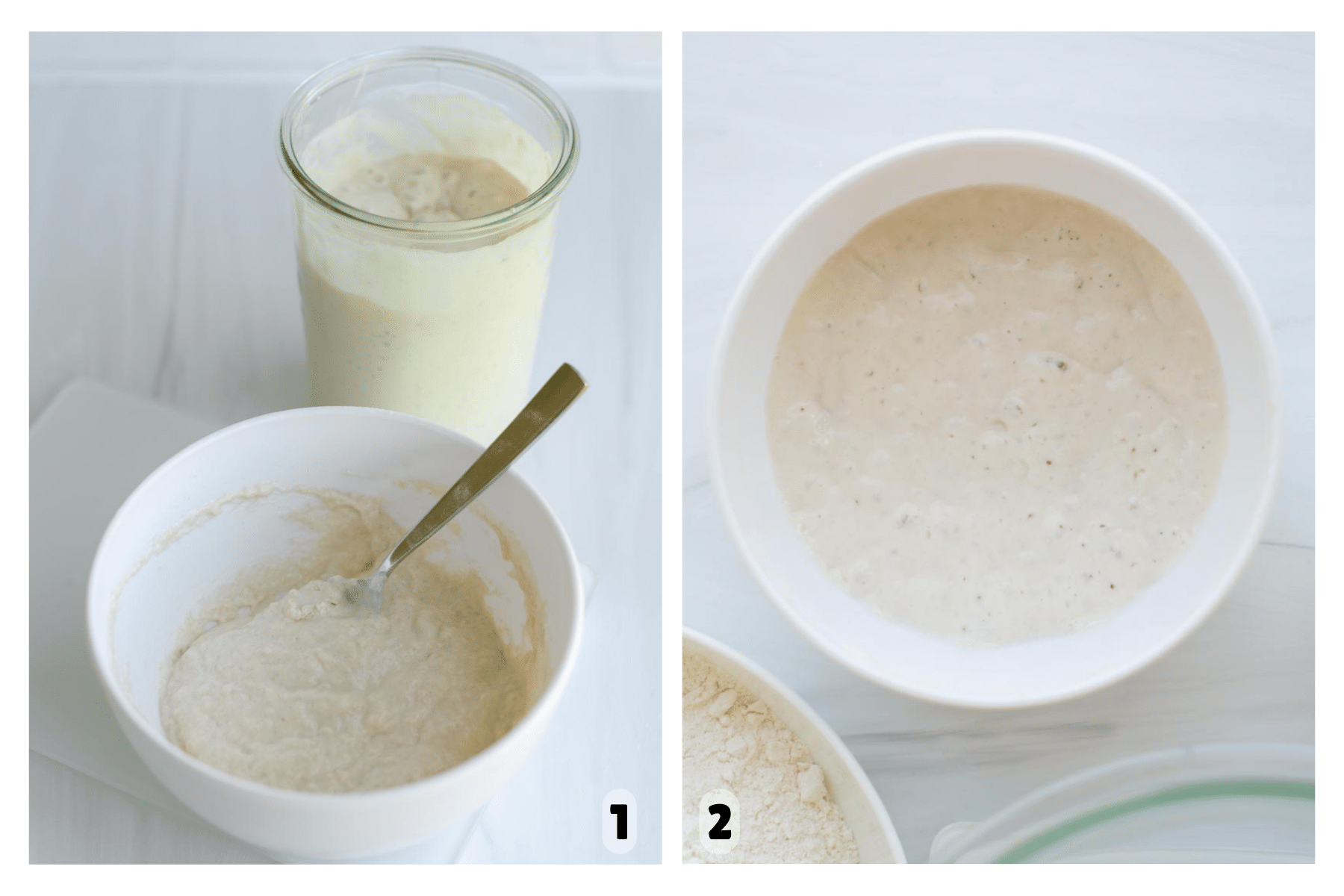
Step 1: Mix the Levain. Combine active sourdough starter with flour and water (Image 1). Cover and let sit in a warm (78ºF) place for 10-12 hours until bubbly, doubled in size, smells milky sweet, and is just about to fall back down (Image 2). Do not use the levain or your sourdough starter if it has not shown these signs. Starter is best to use in its peaked and active state.
Do you have to use a levain in this recipe? No. I prefer it, but if you have a well-maintained and frequently refreshed sourdough starter, you can substitute it in place of the levain in the recipe. A levain is an offshoot of your sourdough starter. It acts as a power feed for your starter, and using one will give you a better loaf.
Fermentolyse (Mix Flour, Water, Levain)
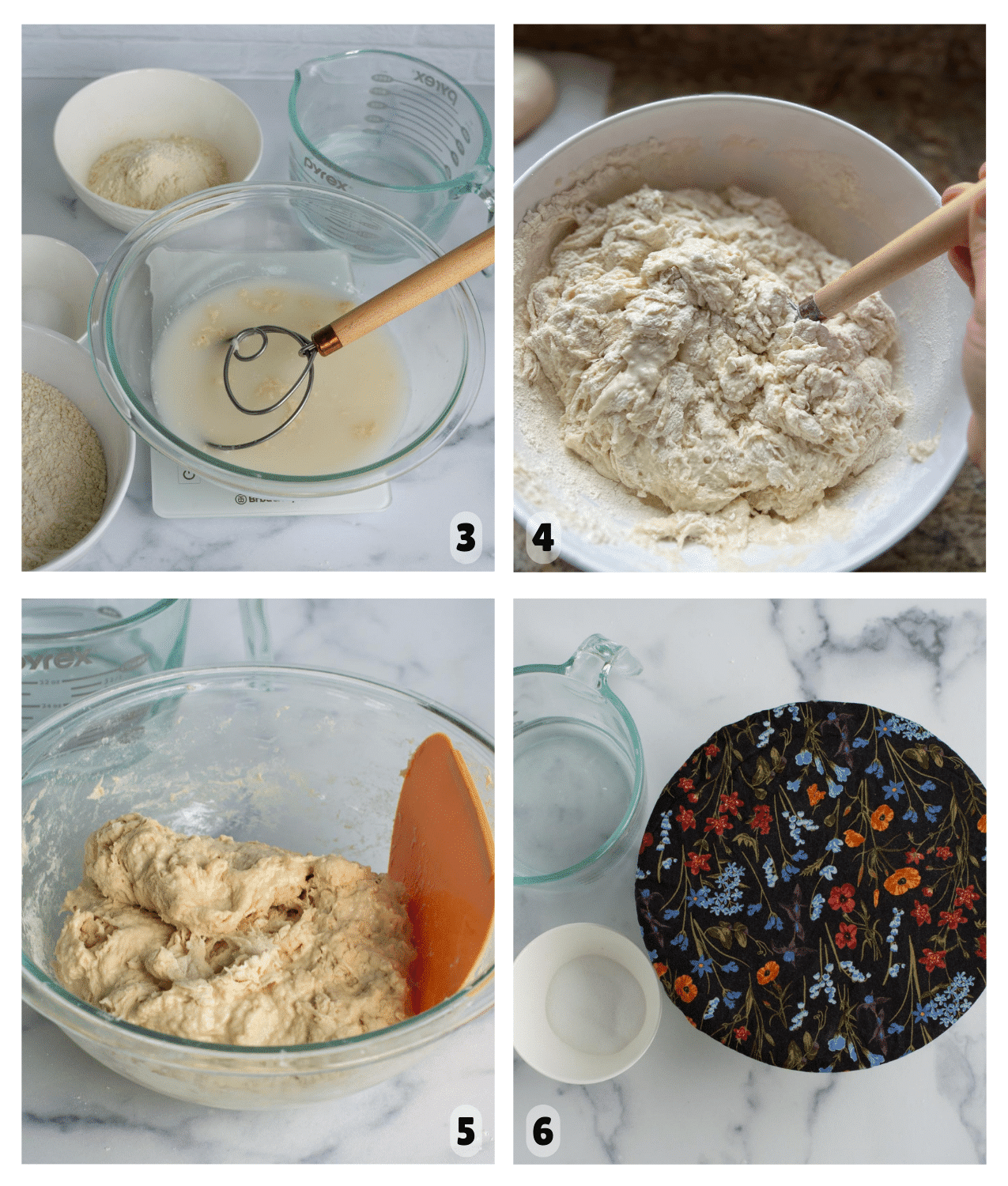
Step 2: Fermentolyse. Use a dough whisk to mix together water and ripe levain in a large mixing bowl (Image 3). Add bread flour and whole wheat flour and mix together until a shaggy dough forms (Image 4 & 5). Cover the bowl and set in a warm place for about 30 minutes. I like to keep the reserved water and salt next to the bowl so I don’t forget to add it (Image 6).
Note: If you prefer to skip the fermentolyse, you can simply mix all the ingredients together at once. Alternatively, you can opt for an autolyse by mixing only the flour and water, then letting it rest for an hour or up to a few hours. After that, incorporate the levain, salt, and reserved water. This method helps build extra strength in the dough.
Mix the Dough
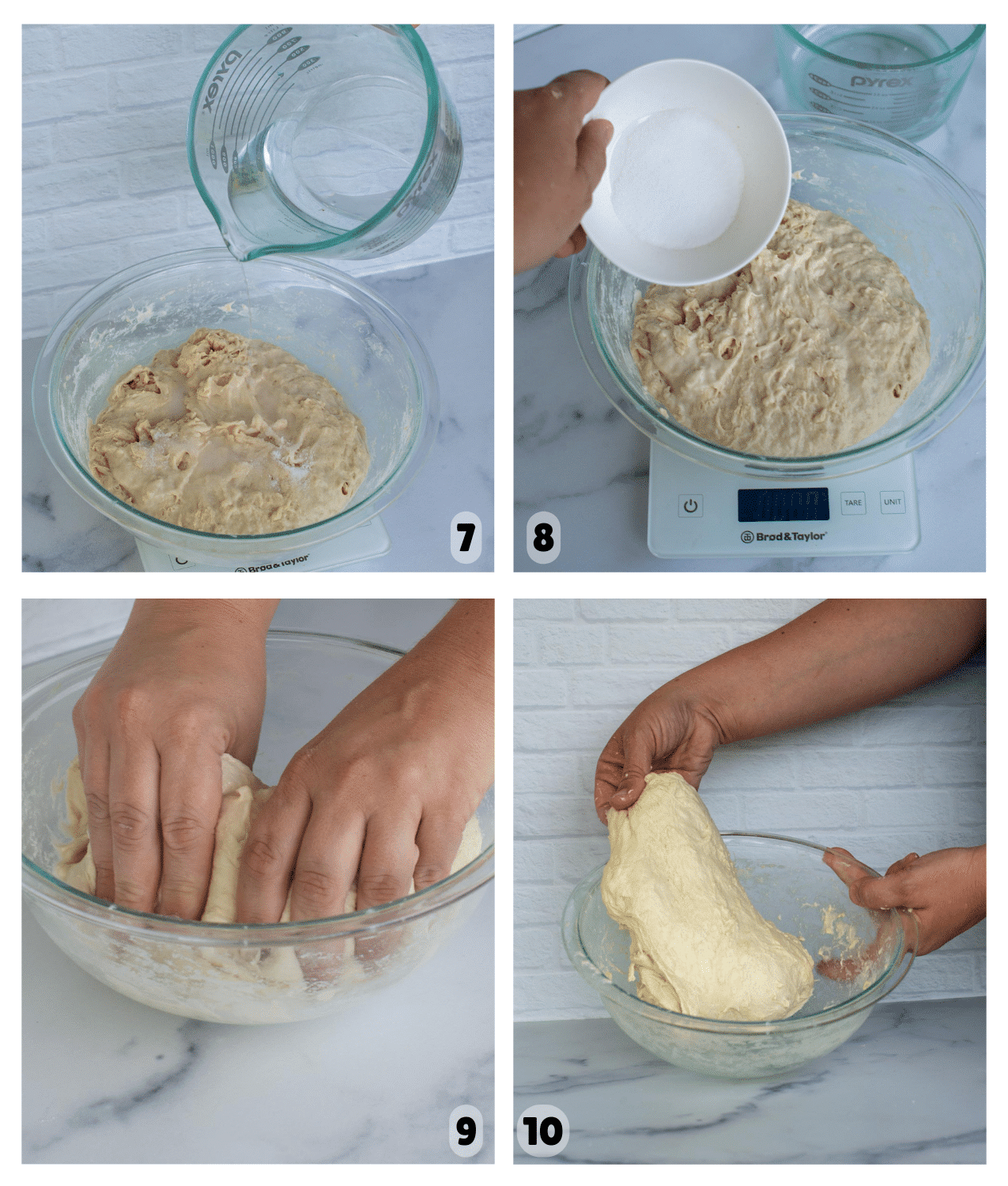
Step 3: Add Reserved Water and Salt. After a 30-minute rest, add the reserved salt and water (Images 7 & 8). Pinch together the dough with your fingers, incorporating the salt and water into the dough as you go. (Image 9).
Salt slows down and tempers fermentation by causing the gluten strands to contract, which is necessary for dough development. A fermentolyse allows the dough to develop more elasticity and strength before the salt is added.
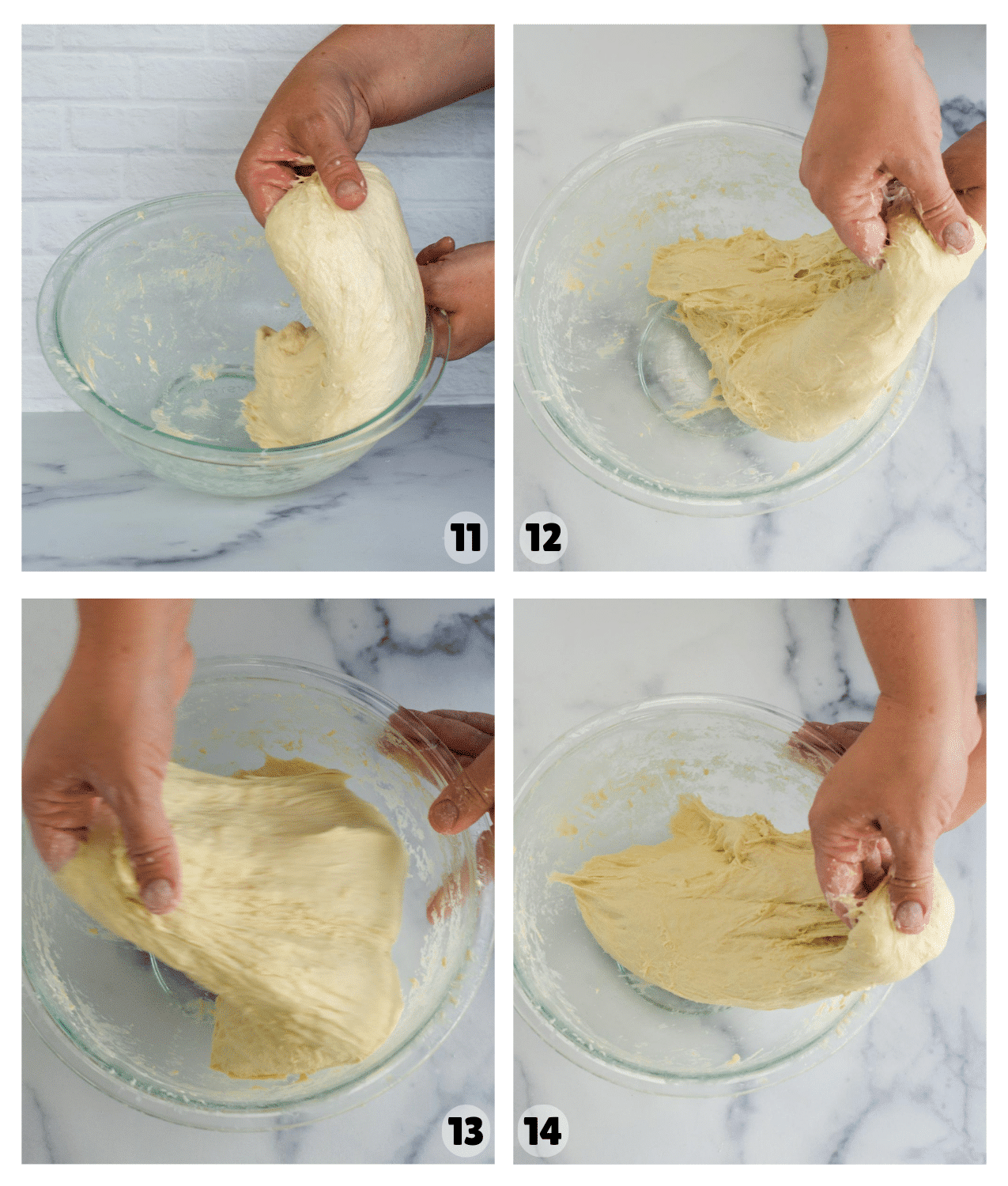
Step 4: Mix the Dough. Take the dough and continue working with it by slapping it against the side of the bowl and quickly pulling it back (Image 10, 11, 12, 13 & 14). This vigorous mixing helps strengthen the gluten strands quickly in the dough and will result in a stronger loaf with more oven spring. After about 3-5 minutes of mixing, the dough will feel more cohesive and strong. Place the dough back in the bowl or transfer to a clear plastic container or a glass bowl if desired. Cover and set aside for 30 minutes.
Bulk Fermentation
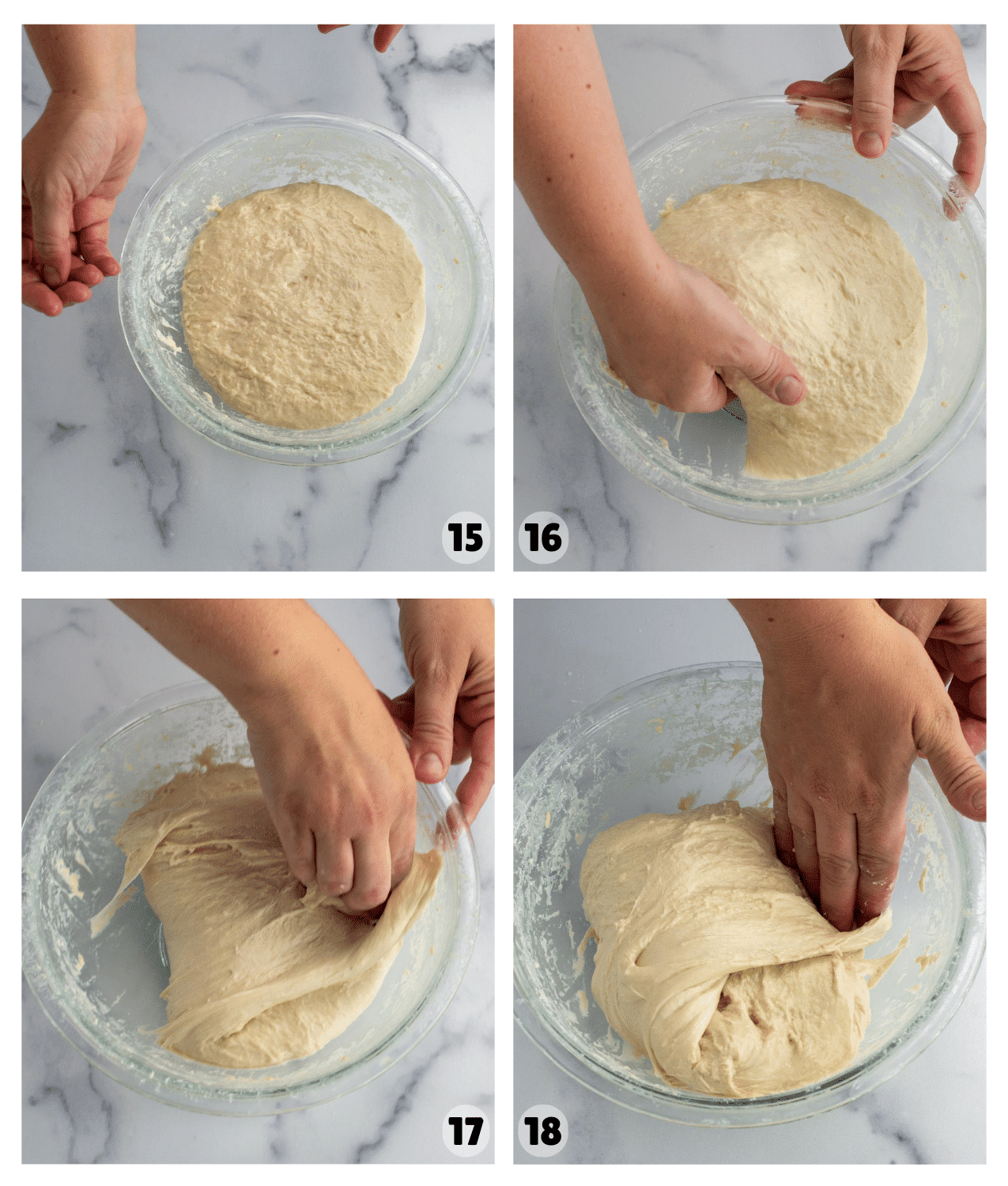
Step 5: Stretch and Folds. After 30 minutes of resting (Image 15) you will perform a series of “stretch and folds” to gently strengthen the dough. To “stretch and fold,” wet your hand (so it doesn’t stick to the dough). Reach down to the bottom of the bowl (Image 16) of dough and pull the dough up and over the top of the dough (Image 17).
Turn the bowl 1/4 turn and repeat the stretch and fold. Turn another quarter turn and repeat. Perform one more 1/4 turn with stretching and folding the dough (Image 18). The more you stretch and fold, the more the dough will resist and tighten up. Once it does that, it’s your sign to stop stretching and folding. Cover the dough and set it aside.
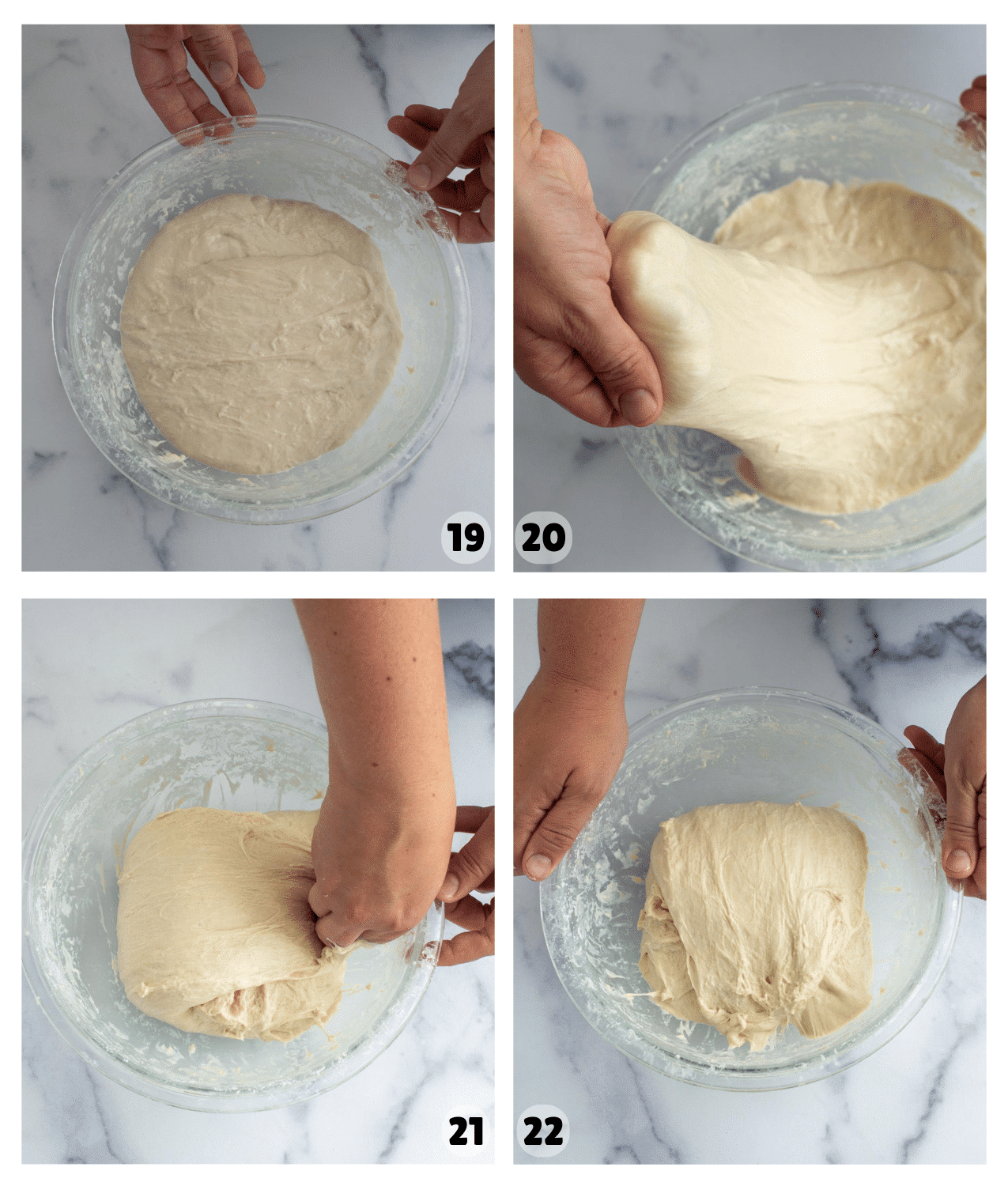
Repeat the series of folds over the course of 1.5-2 hours (Images 19, 20, 21, 22), stretching and folding the dough every 30 minutes until cohesive and strong. If you forget a set of stretch and folds – don’t worry! Just add it back in when you remember.
Visual Learner? Watch the video on how to stretch and fold here.
Note: If you want to add inclusions like cheese, herbs, chocolate chips, dried fruits or nuts, you can add them before the second set of stretch and folds. If you want each of your mini loaves to have a different flavor, I would wait to add your mix-ins until you shape your mini loaves. Some inclusions that affect the bulk fermentation, like cinnamon, should not be added until shaping these mini loaves.
Rest and Finish Bulk Fermentation
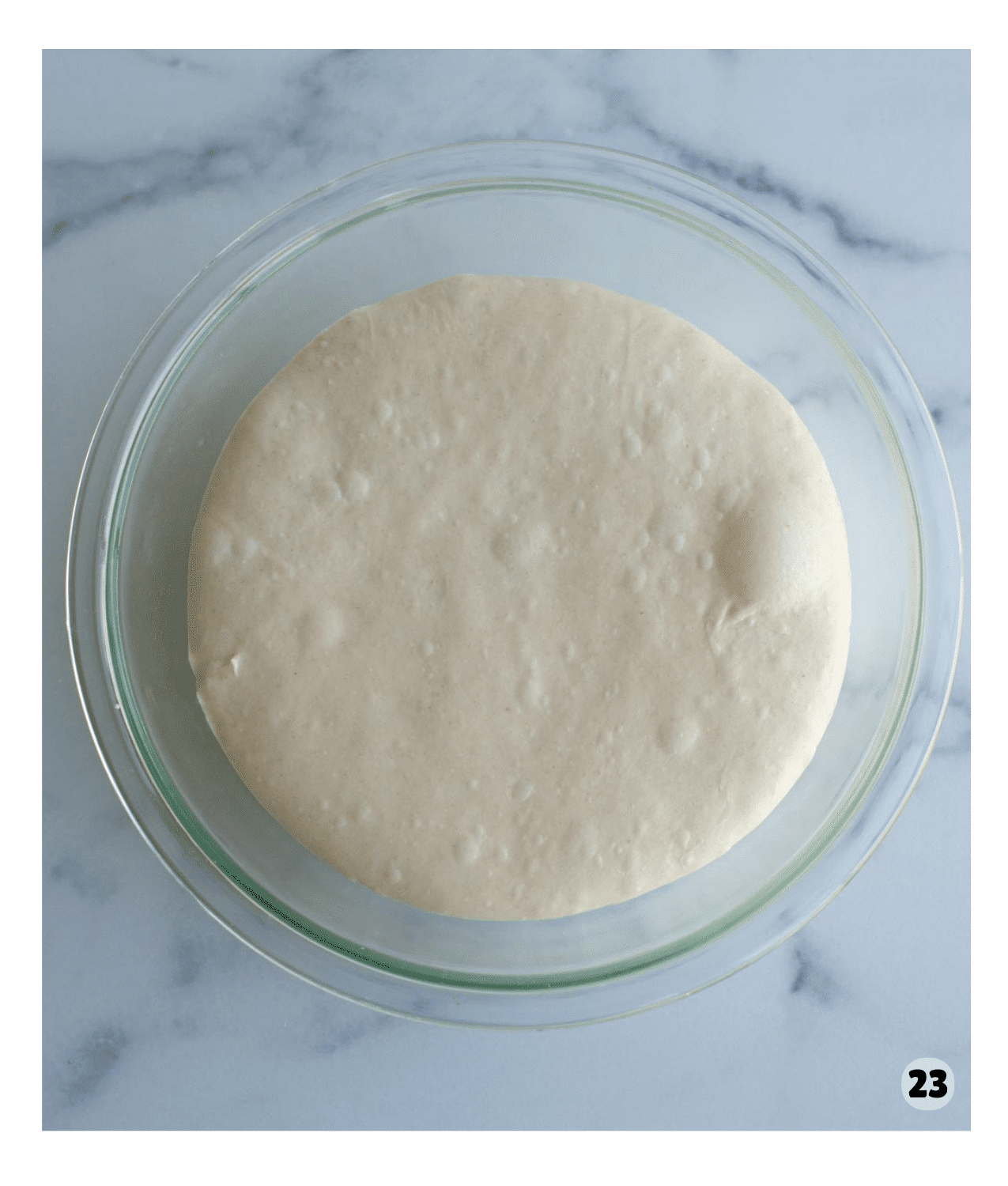
Step 6: Rest and Finish Bulk Fermentation. After the dough is sufficiently strengthened through folds, cover the dough and let it rest and rise at a warm 78-80ºF temperature until it has risen about 30-40%, is doming toward the center, and has some scattered bubbles around the edges (Image 23). Those are the signs that the dough is ready for pre-shaping.
Keep in Mind: If your dough is colder, you will want to see a larger percentage rise in the dough before pre-shaping. Dough that is 70ºF throughout the bulk fermentation will need to rise at least 70% in the bowl before it is ready for pre-shaping.
Divide & Pre-shape the Dough
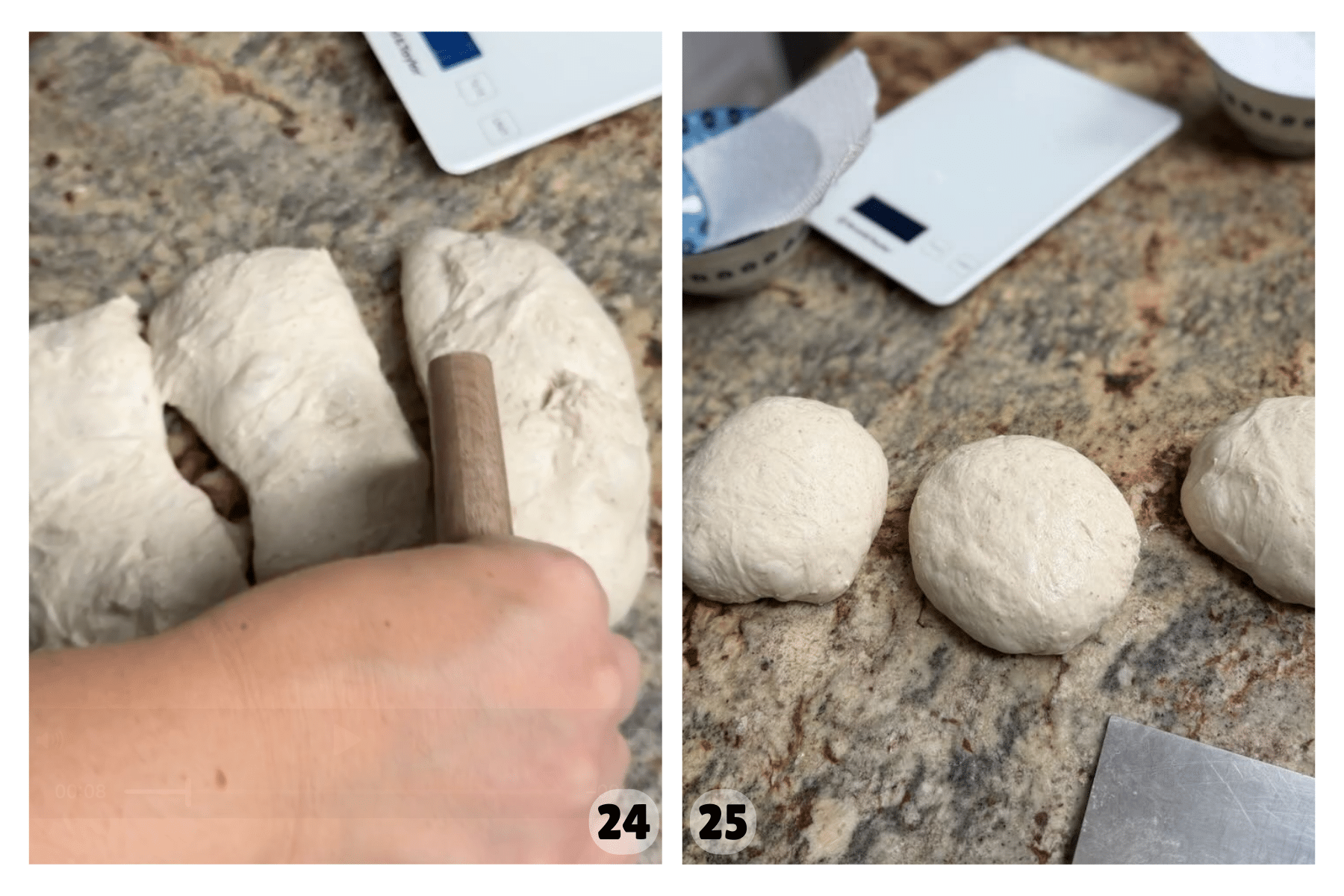
Step 7: Divide Dough. Gently dump the dough on the counter, being careful not to degass the dough. Use a bench knife to divide the dough into three equal portions. Each portion should be about 300-320 grams (Image 24). Pre-shape the dough by using the bench knife to gently tuck the dough under itself, creating tension and a smooth, tight ball of dough. Let your mini loaves rest for about 30 minutes at room temperature (Image 25). It is normal for your dough to flatten a bit during this bench rest process.
Note: If you want to bake three different flavors of mini sourdough bread, this is the time to add your inclusions. Use the lamination method by stretching your dough thin on the counter, being careful not to tear it. Sprinkle your inclusions evenly across the dough and then gently fold your dough into thirds (enclosing the inclusions like a little package). You can add more mix-ins before folding into thirds again, ending in a little package of dough that can be gently rounded and placed in a prepared banneton, mini loaf pan, or small bowl.
Shape The Mini Loaves
Step 8: Shape Mini Loaves. After the 30-minute bench rest, prepare to shape your mini loaves. You have two options for shaping and baking these mini loaves. You can either shape them into round boules and place them in mini banneton baskets or small bowls, OR you can use mini loaf pans.
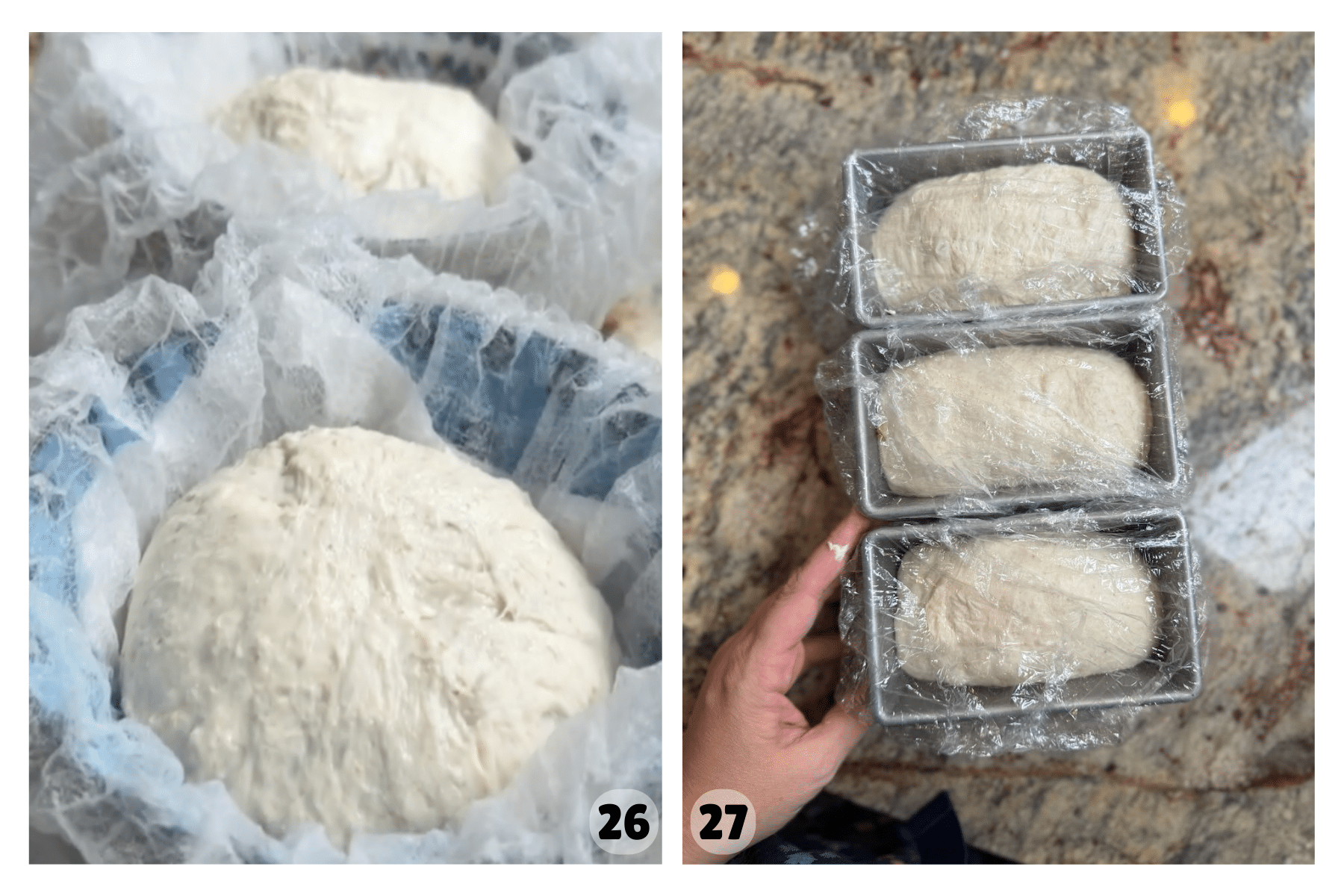
For Round Boules: Pull the dough gently sideways and fold it on top. Repeat this process, turning 90 degrees until you have pulled and folded the dough from each of the four sides. This will increase the tension in the dough as you shape it. Gather the ball of dough into a circle and gently place it into a lined banneton basket or small bowl (Image 26). I like to use these reusable hairnets to line my baskets.
For Mini Loaf Pans: Butter the edges of your loaf pans. Roll the dough into a rectangular shape. Pinch the seam closed and gently place oval-shaped loaves into your mini loaf pans (Image 27).
Step 9: Cold Fermentation. Cover the dough with a shower cap, plastic wrap, or a reusable cover and store the dough in the refrigerator overnight or for up to 14-20 hours. Alternatively, you can skip the cold fermentation and let your dough rise outside the fridge for another 2-3 hours instead, in order to bake your mini loaves of sourdough bread the same day.
Baking Option 1: Dutch Oven
Step 10a: Bake. If using a Dutch oven, preheat your oven to 500°F with your Dutch oven inside for 30 minutes. Every Dutch oven is a little different in size. Some can fit all three mini loaves at once, but don’t worry if yours can’t. Just bake them in batches.
Once the oven is ready, grab your loaves from the fridge. While the dough is still cold, uncover it, lay a piece of parchment on top, and flip it over so the dough is on the parchment paper. Lift off the bowl or banneton.
Dust the top lightly with flour if desired and use a bread lame or sharp knife to make a few shallow decorative scores (about ¼ inch deep), and then add one or two deeper cuts (about 1 inch deep) so the loaf can open up while it rises.
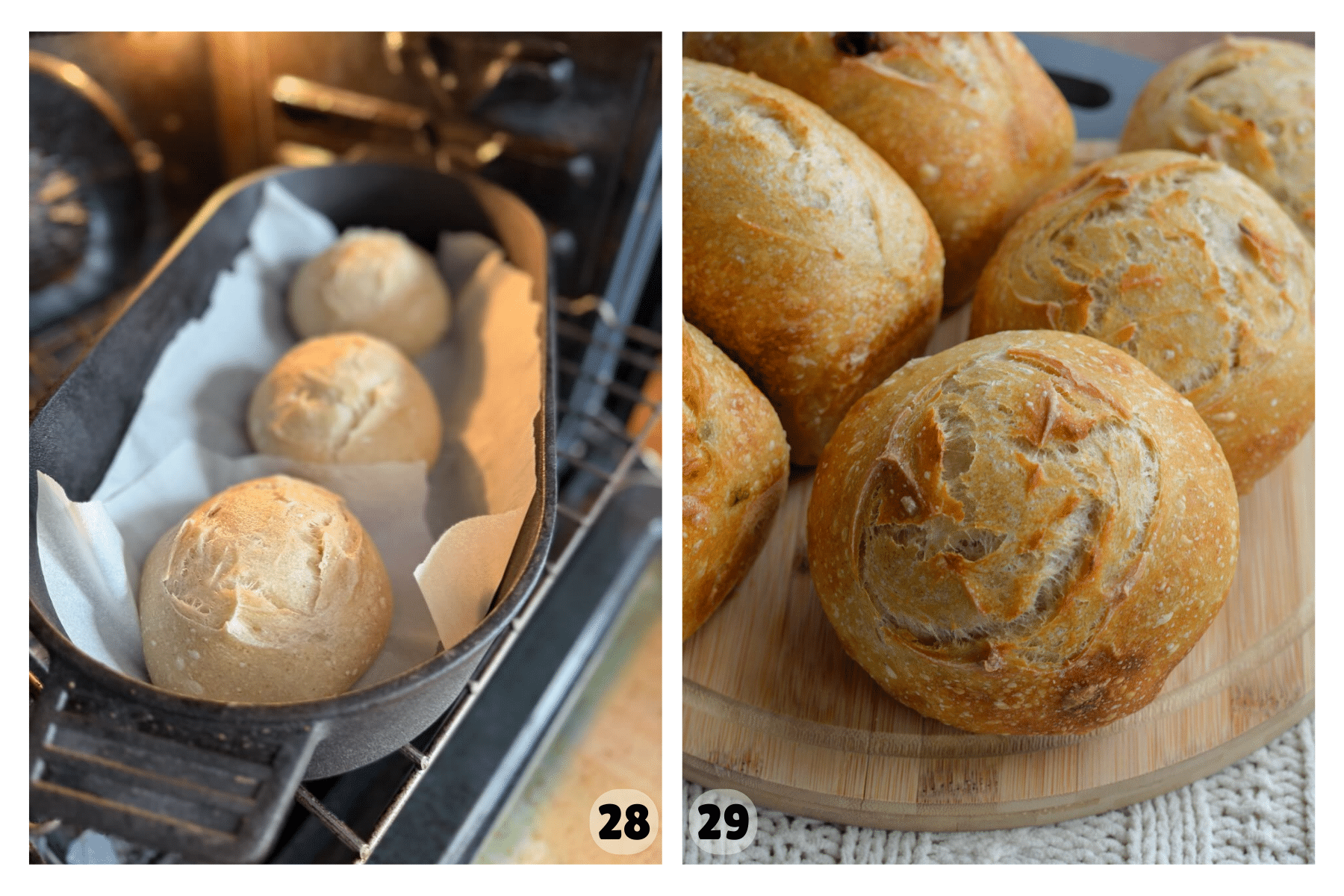
Carefully pull out the hot Dutch oven, take off the lid, and use the parchment to lower your dough inside. Fit as many mini boules as you can without them touching. Cover, slide it back into the oven, and reduce the heat to 450°F. Bake for 20 minutes covered, then remove the lid (Image 28) and bake another 10–15 minutes, until they’re a deep golden brown (Image 29) and the internal temp reads 205–210°F. Remove and cool on a wire rack before gifting.
Can I Open Bake? Yes! You can open-bake these mini loaves just like my sourdough bread bowls. Place a baking stone in your oven, score the dough on parchment, and slide it right onto the hot stone. Add a pan of hot water underneath the loaves and bake for about 20 minutes with the steam, then carefully remove the water and finish baking for another 10–15 minutes.
Just a note: this method doesn’t offer quite as much control as baking in a Dutch oven, and sometimes the loaves can burst. The more you get to know your oven and adjust as needed, the better your results will be with this style of baking.
Baking Option 2: Mini loaf pans
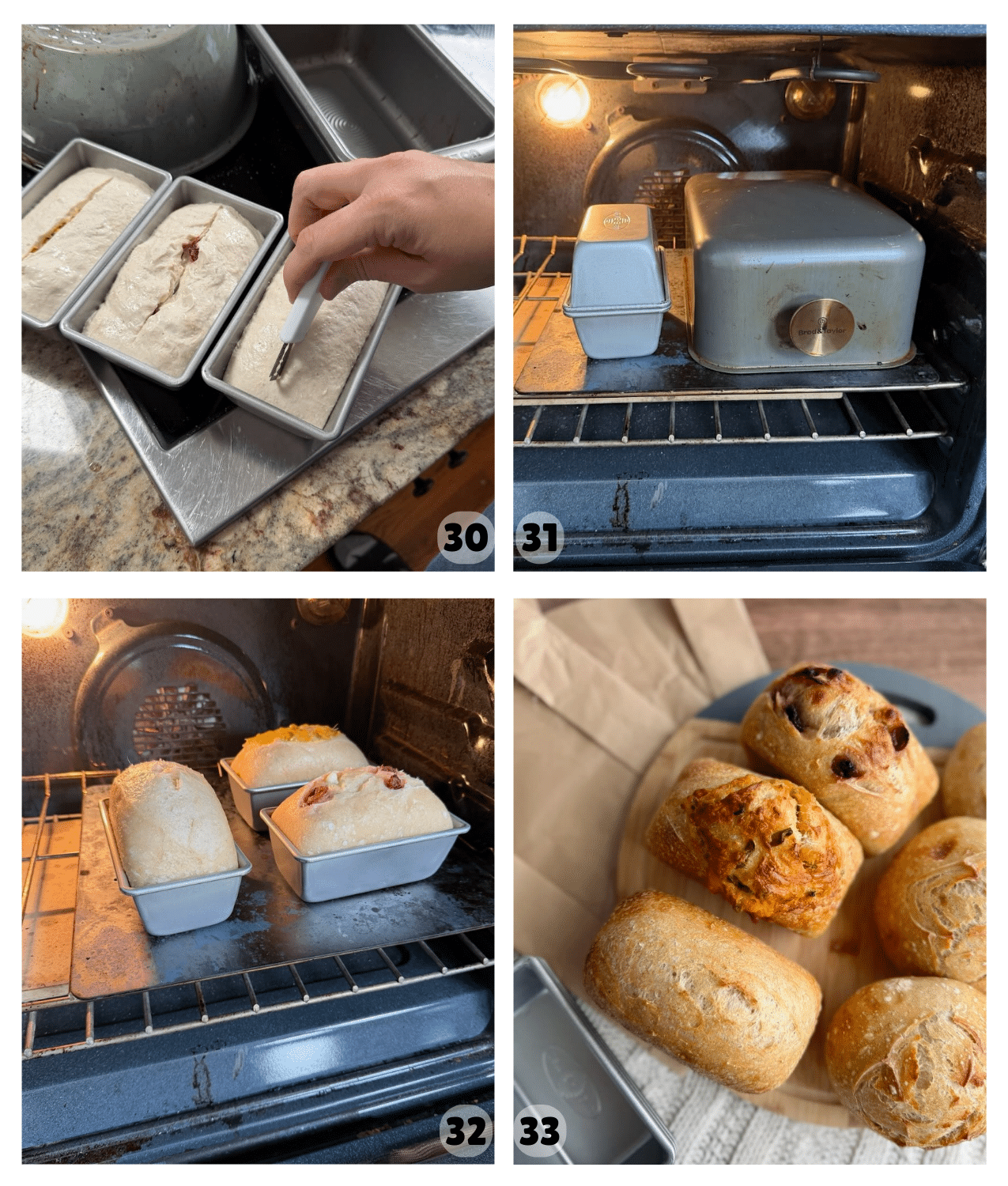
Step 10b: Bake. If you don’t have a Dutch oven or want to shape your sourdough into boules, use mini loaf pans to bake your sourdough bread instead. Preheat the oven to 450°F. Pull the dough out of the refrigerator and score the top (Image 30). Add decorative cuts if you want to, but I usually stick with one large slash down the middle.
To create steam in the oven, place another mini loaf pan upside down on top to create a lid, or use a baking steel/shell if you have one (Image 31). Alternatively, you can place a pan filled with 1 cup of hot water on the bottom rack to create steam.
Bake mini loaves for 20 minutes, then remove the mini loaf pan lid, baking shell, or pan of water (Image 32). Finish baking for 10 to 15 minutes until the loaves are golden and register 205 to 210°F internally. Remove and cool on a baking rack before gifting or slicing and enjoying (Image 33).
Can I Open Bake? Yes! You can open-bake mini loaves. The sides of the mini loaf pan help support the dough as it rises, giving it enough structure even without a loaf pan on top of it. Place the dough in the pan, score the top, and bake in a preheated oven with a pan of hot water underneath for steam. After about 20 minutes, remove the water and finish baking until the loaves are golden and cooked through.
How to Store Leftovers
Store leftover sourdough bread in an airtight container or plastic bread bag at room temperature for a day or two. If gifting, place in a paper bread bag like this one and gift. If you’re keeping the loaves for longer than a day or two, freeze the loaf or slices of bread (put a piece of parchment in between each slice if desired) for best results. Bread can stay frozen for up to a couple of months. Toast straight from the freezer or defrost and warm up before enjoying.
Amy’s Recipe Tips
This mini sourdough bread method works with any classic sourdough recipe. Follow the tips for dividing, shaping, and baking the loaves, and aim for portions around 300 grams each. You can also divide the dough into two instead of three for slightly larger loaves, just add a bit more baking time. This recipe doubles beautifully for 6 mini loaves and even triples for 9.
Frequently Asked Questions
I like to add them in with the second set of stretch and folds or sometimes I will laminate inclusions in the dough after rising. Choose one of my top 10 sourdough add-ins to try in your next loaf and learn how to add inclusions to any sourdough recipe!
Yes! This recipe is based on my Classic Sourdough Bread recipe. Instead of dividing into mini loaves, shape into one loaf instead. Bake in a Dutch oven or loaf pan for 25-30 minutes with steam and 15-20 minutes without.
Yes! You can make these into mini rolls. Divide the dough into 12 equal pieces, shape them, and pop them into a muffin tin. Let them rise (or stick the whole tin in the fridge for a cold ferment). When you’re ready to bake, heat the oven to 450ºF and place a second muffin tin upside down on top. This traps steam and gives a good rise. Bake for 20 minutes with the tin on, then take it off and bake another 10–15 minutes until they’re golden and perfect. They turn out mini and so good every time!
Mini sourdough loaves are usually 300–320 grams of dough. At this size, they typically bake for 30–35 minutes total, about 20 minutes with steam and another 10–15 minutes without, until the internal temperature reaches 205–210ºF.
You can. I love using the levain method because it makes sure your starter is at its absolute best before you mix your dough. It should be ripe, bubbly, and ready to work. A strong starter or levain is the key to every great sourdough loaf, and using a levain is like an insurance policy that gives you confidence your dough will rise the way it should.
That said, if you have a consistently fed sourdough starter that is ripe, bubbly, and active, it isn’t always necessary. In most cases, you can swap in an active starter and still get great results. But if you’re ever unsure, a levain is an easy way to double-check that your starter is ready to go.
Sourdough Favorites


If you tried these Mini Sourdough Loaves or any other recipe on my website leave a 🌟 star rating and let me know how it went in the comments below. Happy Baking!

How to Make Mini Sourdough Loaves
Save this for later!
Equipment
- mini loaf tins optional
- Dutch oven optional
Ingredients
Levain (1:10:10, overnight 10-12 hours at 78ºF)
- 5 grams sourdough starter, ripe, bubbly and active, about 1 teaspoon, see recipe notes
- 50 grams bread flour, about 1/3 cup
- 50 grams water, about 3 Tablespoons
Sourdough Bread Dough
- 100 grams levain, ripe and active, scant 1/2 cup
- 350 grams water, divided, 325 grams/1 1/3 cups for mixing the dough, 25 grams/2 Tablespoons reserved for AFTER fermentolyse
- 450 grams bread flour, about 3 1/4 cups
- 50 grams whole wheat flour, about 1/3 cup
- 10 grams salt, about 1.5 teaspoons
Instructions
Day 1: Evening, Mix Levain (1:10:10, overnight 10-12 hours at 78ºF)
- Mix together ripe sourdough starter, bread flour, and water. Set aside to ripen for 10-12 hours. Note: Ripe, bubbly, active sourdough starter can be substituted for levain in this recipe if desired.
Day 2: Mix Dough/Bulk Fermentation/Shape/Cold Bulk Fermentation (78ºF)
- Fermentolyse: Once the levain is peaked and active (bubbly, doubled in size, milky sweet smell), mix 100 grams levain with 325 grams of water in a large bowl. Warm the water if the ingredients are too cold and cool the water if the ingredients are too warm. Add 450 grams of bread flour and 50 grams of whole wheat flour to the bowl and mix until incorporated,and a shaggy dough forms. Cover and let rest for 30 minutes. Watch the process here.Note: If you don't have whole wheat flour, you can substitute with 50 grams bread flour and add a little extra time for the dough to rise.
- Mixing: After 30 minutes, add the reserved 10 grams of salt and 25 grams of water. Combine using your hands by squeezing the dough between your fingers, pinching chunks of dough, and reincorporating together. The dough will break apart and then reform in the bowl through this process. Pick up one side of the dough and fold it over on itself. The dough will be sticky. Wet your hands as needed and continue to work with the dough until all the salt and water have been incorporated. Take the dough and continue working with it by slapping it against the side of the bowl and quickly pulling it back. This vigorous mixing helps strengthen the gluten strands quickly in the dough and will result in a stronger loaf with more oven spring. After about 3-5 minutes of mixing, the dough will feel more cohesive and strong. Place the dough back in the bowl or transfer to a clear plastic container or a glass bowl if desired. Cover and set aside for 30 minutes. Watch the process here.
- Bulk Fermentation: Perform 3-4 sets of "stretch and folds." To “stretch and fold,” wet your hand (so it doesn’t stick to the dough). Reach down to the bottom of the bowl of dough and pull the dough up and over the top of the dough. Turn the bowl 1/4 turn and repeat the stretch and fold. Turn another quarter turn and repeat. Perform one more 1/4 turn with stretching and folding the dough. Cover and set aside. Repeat the series of stretch and folds every 30 minutes over the course of two hours. Watch the process here.Note: If you’re adding nuts, dried fruit, or cheese to your sourdough, I like to mix them in during the second set of stretch and folds. If I want each mini loaf to be a different flavor, I wait and add the inclusions after dividing the dough.
- Finish Bulk Fermentation: Let the dough rest in a warm place for the rest of bulk fermentation, about 1 1/2 – 2 hours at 78ºF. During this time, the dough will puff up about 30-40%, become more aerated, start to pull away from the edges of the bowl, and have a few scattered bubbles around the edges/top of the dough. If your dough is not showing these signs, make sure it's warm enough and give it another half an hour or so until it is showing those signs that it's ready to shape.
- Divide: Tip the bowl upside down, allowing the dough to fall onto a clean counter surface. Be gentle to avoid cutting and degassing the dough as much as possible. Use a bench knife to cut the dough into three equal portions, about 300-320 grams each.At this point, if you want to add inclusions to the loaves to make different flavored sourdough loaves, this is the time to do it. Use the lamination method to add inclusions to your loaves.
- Pre-Shape: Using damp hands and a bench knife, push the bench knife under the dough while using your free hand to tuck the dough under itself. Repeat this process going around in a circle until you have a tight ball of dough. Repeat with the second and third loaves.
- Bench Rest: Let the dough rest uncovered for about 30 minutes at room temperature. The dough will flatten a bit during this period of time.
- Prepare the bowls or mini loaf pans: Prepare three small bowls or mini bannetons. Place a kitchen towel or hair net in each bowl. Liberally flour each bowl. If using mini loaf pans, butter the edges of the pan if needed.
- Shaping: After the dough has rested for about 30 minutes, it is time to shape the bread into a round. Sprinkle flour on top of the dough (if desired). Using the bench knife, lift the dough up off the counter and place it on top of the countertop–floured side down. This ensures that the flour stays mainly on the outside of the dough. For round boules: Going around in a circle, pull the dough sideways towards you and then fold up to the top of the round. Move 90 degrees and repeat the same process, pulling the dough sideways and then folding up to the top. As you continue this process around the dough, increase the tension as you pull. Gather the bread into a circle and use a bench knife to lift the bread and place it into your lined bowl. Repeat with the other loaves. Watch the process here.For mini loaf pans: Roll the dough up into a rectangular shape, pinching together the seam, and place seam-side down in the mini loaf pan.
- Cold Fermentation: Cover the dough with a shower cap, plastic wrap or a reusable cover and store the dough in the refrigerator overnight or for up to 12-24 hours. Alternatively, you can let your dough rise outside the fridge for another 2-3 hours, keeping the dough at that 78º F temperature, and then bake your loaves the same day.
Day 3: Score and Bake
- Dutch Oven Method: Preheat your oven to 500ºF with your Dutch oven inside for 30 minutes. Depending on the size of your Dutch oven, you may be able to bake all three loaves at once or you may need to bake them in batches.When the oven is ready, pull your loaves out of the refrigerator. Remove the cover while the dough is still cold, place a piece of parchment on top, and flip the dough so it rests on the parchment. Lift off the bowl or banneton and towel. Lightly smooth flour over the top and score the dough with a few shallow decorative cuts about 1/4 inch deep, then one or two deeper slashes about 1 inch deep.Carefully remove the hot Dutch oven, take off the lid, and lower the dough inside using the parchment paper. Add as many mini boules as you can while keeping them from touching each other. Cover and return the Dutch oven to the oven, then lower the temperature to 450ºF. Bake for 20 minutes covered, then uncover and bake for 10 to 15 minutes until the loaves are deeply golden and register 205 to 210ºF internally. Remove and cool loaves on a baking rack.
- Mini Loaf Pan Method: Preheat the oven to 450ºF. Pull the dough out of the refrigerator and score the top. Add decorative cuts if you want to, but I usually stick with one large slash down the middle. Place another mini loaf pan upside down on top to create a lid, or use a baking shell if you have one. You can also place a pan filled with 1 cup of hot water on the bottom rack to create steam.Bake for 20 minutes, then remove the mini loaf pan, baking shell, or pan of water. Finish baking for 10 to 15 minutes until the loaves are deeply golden and register 205 to 210ºF internally. Remove and cool on a baking rack.
- Let loaves cool completely, then wrap and enjoy!
Video
Notes
Nutrition
Nutrition information is automatically calculated, so should only be used as an approximation.


Please tell us how to use the Bosch mixer with our sourdough loaves. Do you just use it to mix when feeding your starter? I’ve never seen it used for stretch and folds.
Check out this recipe for Stand Mixer Sourdough if you want to make an artisan-style loaf. The Bosch is great for sandwich bread and other enriched doughs, especially when making multiple loaves.
Omigosh! I will be making these. Perfect for a household of two! I have a mini-loaf pan that bakes 8 loaves. Could I use that pan to make three?
They are really great! That pan should work. Enjoy!
Hi…
Love this recipe, here is my question…
I am just having stick dough, is this common for you.
I do add more flour to my dough when mixing .
And could maybe this be more of my problem???
I have some starter and use the amount I need for other bread, so instead of taken what I have left over for discard I am using it to make the min loafs…
Could this be making my dough stick and when I mean sticky it will stick to my fingers and hard to shape, also when I go to score the loafs my blade will tear and drag through my dough….
Help… thank you
Sticky dough is normal with sourdough, but adding too much extra flour can actually throw things off and make shaping harder. Next time, try using the recipe amounts as written, let the dough rest, and use light flour or a damp hand + bench scraper for shaping. It should feel tacky when you shape it, but not unmanageable.
Thank you.
I made this yesterday use my bench scraper and did some coil foils and it helped .
Thank you for your help
I’m glad it helped! Enjoy!
Can I place the mini loaf pans inside my Dutch oven to bake? I only have 8 mini pans so I figured I can cover some with the another mini pan and bake the other loaves inside my cast iron Dutch oven. Just want to see if you think this would work.
I don’t know if the heat would conduct as well that way. Covering them with the other mini pans would work well. You could bake in batches, or you can use a pan of ice cubes to create steam in your oven.
Loved it! I like sweets and my husband likes savory. Great idea for gifts to friends, family, coworker, and to make savory and sweetness options. Can’t wait to try more inclusions. I have 2 extra mini loaf pans to bake 4 instead of 3, any suggestion on how much to add to levain and other ingredients to make and divide to make 4 mini loaves???
Thanks! Mini loaves are my favorite way to bake them now!!!
I love mini loaves too! Thanks for the review! I haven’t tried to scale it up like that. I would probably just double the recipe, bake in batches, and freeze or gift the extras.
How much can I use for inclusions with these mini loaves without it being too much?!!
For this dough (500g total flour), I’d keep inclusions around 75–125g total for the full batch, which breaks down to about 25–40g per mini loaf. That gives you plenty of flavor without weighing the dough down. If you go much over 150g total, it can start to affect the rise and texture.
I’d like to add inclusions to these loaves that I plan on baking, but because they are mini loaves, can you please give me a ratio of how much inclusion to use in each. Thanks so much in advance, Amy!
For this dough (500g total flour), I’d keep inclusions around 75–125g total for the full batch, which breaks down to about 25–40g per mini loaf. That gives you plenty of flavor without weighing the dough down. If you go much over 150g total, it can start to affect the rise and texture.
Hi Amy
FYI
Just wanted to let you know that I « almost » made a big mistake.
I used the counter to double the recipe. So far so good.
BUT once I started faithfully follow your INSTRUCTIONS everything went askew.
The instructions say add 450 gr bread flour….should have said 900 gr bread flour.
But I caught it in time to adjust.
I’m glad you caught it! The instructions won’t change when you click the double or triple recipe feature.
Hi Amy – fyi – if I adjust the # of loaves to 2 – the recipe instructions don’t adjust. A little confusing…
Yes, the website feature automatically changes the gram/weight measurements but it doesn’t change the cup measurements. Sorry about the confusion!