
Affiliate disclosure: This post may contain affiliate links. Please see our disclosure policy.
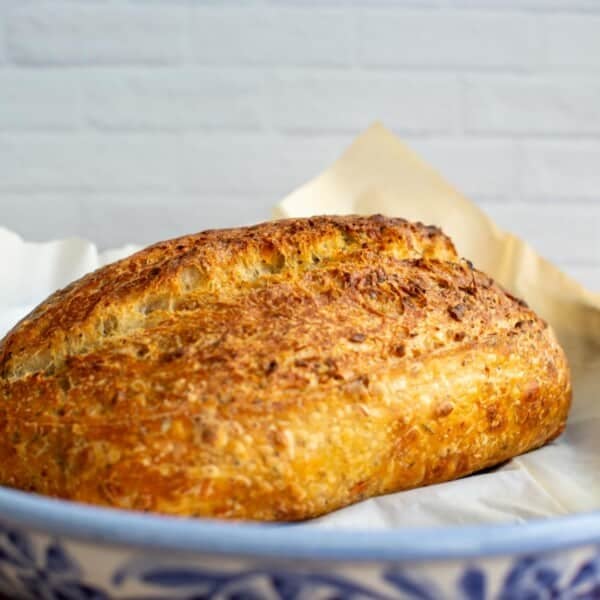
You are going to love this hearty artisan loaf of Oatmeal Sourdough Bread. Made with a combination of rolled oats, white and whole wheat flour, and honey, you’ll love the robust flavor of this nutritious bread. I especially love using it for sandwiches – YUM!
Anytime I can incorporate whole grains in my baking – I try to do it! Just like my favorite Multigrain Sourdough Bread that is made from multigrain cereal and whole wheat, this oatmeal sourdough artisan loaf is full of nutrients that don’t compromise on taste!

Save this for later!
Why You’ll Love Oatmeal Sourdough Bread
- Honey and Whole Grains – The combination of bread flour, whole wheat flour, oats and honey makes for a hearty artisan loaf that is still full of flavor. If you prefer even more whole wheat flavor, then try my Honey Whole Wheat Sourdough Bread.
- Nutritional Benefits – I love that this oatmeal loaf combines the nutritional benefits of whole grains and 100% sourdough for the perfect bake. If you’re looking for a quicker discard whole wheat version, then try this Honey Whole Wheat Sourdough Discard Bread. Or try my Einkorn Sourdough Bread for even more nutrition!
- Rolled Oats – You’ll love that this oatmeal loaf incorporates rolled oats for the soft chewy texture and slightly nutty flavor they give. If you want a non-sourdough alternative, try this Honey Oatmeal Bread instead!
If you are new to sourdough, learn how to make a sourdough starter from scratch and how to maintain a starter in my Free Sourdough Beginner Guide. Using naturally fermented sourdough will take much longer, but you will love the fermentation benefits and the flavor!
Important Ingredients

- Sourdough Starter – Use an active/ripe sourdough starter (doubled in size/bubbly/mild sour aroma) to mix the levain. Ripe, bubbly, active sourdough starter can be used in place of levain if desired.
- Rolled Oats – I like to use whole old-fashioned, rolled oats for this recipe.
- Honey – A little bit of honey sweetens this oatmeal loaf.
See the recipe card for full information on ingredients and quantities
Substitutions
- Bread Flour: This recipe uses mostly bread flour, but you could increase the ratio of whole wheat flour if you prefer. You may want to refer to my guide on baking with whole wheat flour for tips.
- Levain: Bubbly and active sourdough starter can be substituted for levain in this recipe.
- Rolled Oats: This recipe calls for rolled oats. You could use quick oats, but they will dissolve more into the loaf and you won’t get any of the texture that the rolled oats bring.
Sourdough Baker’s Timeline
A sample baking schedule helps me when baking with sourdough. Sourdough takes much longer to rise than commercial yeast bread. This schedule helps me plan my bake.
A few notes: This schedule assumes the dough temperature is 78-80°F throughout the process. If you’d like to make the bread all on the same day, skip the cold fermentation and let the dough rise for a few hours in a banneton or bowl before baking.
| Day 1 | Levain/Mixing/Bulk Fermentation/Shaping/Cold Fermentation |
| 8:00 AM –11:30 AM | Mix Levain. Let sit at 78°F for about 3-4 hours until doubled/bubbly and ripe. |
| 10:30 AM | Mix Oats with very hot or boiling water |
| 11:30 AM | Mix Dough |
| 12:00 PM | Stretch and Fold #1 |
| 12:30 PM | Stretch and Fold #2 |
| 1:00 PM | Stretch and Fold #3 |
| 1:30 PM | Stretch and Fold #4 |
| 3:30 PM | Bench Rest |
| 4:00 PM | Shape dough Begin cold fermentation |
| Day 2 | |
| 9:00 AM | Preheat Dutch oven |
| 9:30 AM | Score and Bake |
How to Make Oatmeal Sourdough Bread
Mix Levain

Step 1: Mix Levain. Combine ripe sourdough starter with water and flour to prepare your levain (Image 1). Let rise for about 3-4 hours until bubbly and active (Image 2).
Note: If you have a ripe, bubbly, active sourdough starter that is fed equal parts flour and water – it can be substituted for the levain in this recipe.
Mix Oatmeal Sourdough Dough

Step 2: Mix the Dough. About 30 minutes to an hour before the levain is ready, prepare the oatmeal porridge by mixing oatmeal and very hot/boiling water together and let cool (Image 3). Once the porridge cools, mix together ripe levain, oatmeal porridge, water and honey until mostly incorporated (Image 4). Add the salt, bread flour and whole wheat flour (Image 5). Mix together with a Danish dough whisk until fully combined (Image 6). Cover and let rest for 30 minutes.
Amy’s Tip: If you prefer to use a stand mixer, you can use the tips in my Sourdough in a Stand Mixer recipe instead of mixing the dough by hand.
Bulk Fermentation & Gentle Folds

Step 3: Bulk Fermentation and Stretch and Folds. After the dough has rested (Image 7), perform a series of 3-4 sets of stretch and folds over a 1 1/2 hour period. To “stretch and fold,” wet your hand (so it doesn’t stick to the dough). Reach down to the bottom of the bowl of dough and pull the dough up and over the top of the dough (Images 8 & 9).
Turn the bowl a quarter turn and repeat the stretch and fold. Turn another quarter turn and repeat. Perform one more quarter turn with stretching and folding the dough. Cover and set aside for 30 minutes. Repeat every 30 minutes for a total of 3-4 times until the dough has strengthened (Image 10). Let the dough rest in a warm 78ºF place for about 2 hours until risen about 40%, is jiggly and has a few scattered bubbles around the edges.
Temperature: If the temperature of your dough is cooler than 78ºF, it will take longer for your dough to rise. If your dough is warmer, the dough will move faster through the fermentation process and will rise faster.
Pre-Shape & Bench Rest

Step 4: Pre-Shape. After allowing the dough to rest for about 2 more hours until scattered bubbles are visible, tip the dough onto a clean counter (Images 11 & 12). Use a bench knife to tuck the dough under itself and create some tension in the dough, forming a circular ball of dough (Images 13 & 14).

Step 5: Bench Rest: Let the dough rest uncovered for about 30 minutes at room temperature to allow the gluten in the dough to relax and prepare the dough to be shaped.
Shaping The Dough


Step 6: Shape Dough. Going around in a circle, pull the dough sideways towards you and then fold up to the top of the round (Image 15). Move 90 degrees and repeat the same process pulling the dough sideways and then folding up to the top (Image 16). Continue in a circle, increasing tension until you have shaped your dough (Images 17 & 18). Dip the outside of the bread in oats (Image 19) and place in banneton proofing basket with the seam side up (Images 20, 21, & 22).
Cold Fermentation

Step 7: Cold Fermentation. Cover the dough and refrigerate for 14-20 hours (Image 23). Alternatively, you can allow the dough to rise for 3-4 hours until puffed and risen (Image 24).
Baking Oatmeal Sourdough Bread

Step 8: Bake. Prepare a Dutch oven by preheating it in the oven at 500°F for 30 minutes. Score the oatmeal bread by using a very sharp knife or bread lame (Images 25, 26 & 27). Decrease the temperature to 450ºF and bake the bread in a covered Dutch oven for 25 minutes. Then uncover and bake for 20 more minutes until the bread is a crackly deep brown (Image 28). Remove from Dutch oven and cool completely before slicing. Enjoy!
How to Store Leftovers
I like to let my loaf cool completely. Then slice, stick in an airtight bag and freeze. You can also freeze the whole loaf of sourdough oatmeal bread and then let it thaw or warm back up in the oven for a few minutes before enjoying.
AMY’S Recipe Tip
Sometimes I like baking this Oatmeal Sourdough Bread in a loaf pan instead of a Dutch oven. The loaf pan make it easy to slice with the same great flavor. Use a 9 by 5 loaf pan for this amount of dough and follow my guide on baking sourdough in a loaf pan.
Frequently Asked Questions
No. You can substitute a ripe, bubbly, active sourdough starter for the levain in this recipe if desired.
Yes! You can skip the cold fermentation completely and let the dough rise in a warm place on your counter. After a couple of hours the dough should be puffed up and risen in the banneton. Stick the dough in the freezer for 20 minutes while your oven pre-heats so that it is easy to score and then bake.
Yes! But you need to make a few modifications. You’ll want to reduce the levain or starter in the recipe to about 50 grams instead of 100 grams. You’ll also want the dough to rise at a lower temperature – around 76ºF (so be careful of this method in the summertime when it’s warmer) so it doesn’t overproof while you’re sleeping. Once the dough has risen, shape it and proceed with the recipe – either cold-fermenting the dough or letting it rise at room temperature and baking it.

Sourdough Bread Recipes You’ll Love



If you tried this Oatmeal Sourdough Bread or any other recipe on my website leave a 🌟 star rating and let me know how it went in the comments below. Happy Baking!

Oatmeal Sourdough Bread
Save this for later!
Ingredients
Mix Levain (1:1:1 ratio, ready in 3-4 hours at 78-80ºF)
- 35 grams ripe, active sourdough starter, about 2 Tablespoons
- 35 grams water, about 2 Tablespoons
- 35 grams all-purpose or bread flour, about 1/4 cup
Oatmeal Sourdough Bread
- 160 grams rolled oats, about 1 ¾ cup, see recipe notes
- 250 grams hot water, about 1 cup, very hot or boiling
- 100 grams levain, scant 1/2 cup, see recipe notes
- 200 grams water, about 3/4 cup plus 2 Tablespoons
- 40 grams honey, about 2 Tablespoons
- 12 grams salt, about 2 teaspoons
- 350 grams bread flour, about 2.5 cups
- 50 grams whole wheat flour, about 1/3 cup
- 45 grams oats for topping, about 1/2 cup in a shallow bowl
Instructions
Mix Levain (1:1:1 ratio, ready in 3-4 hours at 78-80ºF)
- Mix together ripe/active sourdough starter with all-purpose or bread flour and water. Cover loosely and let sit 3-4 hours at 78-80°F until doubled, bubbly & peaked.Note: If you have a ripe, bubbly, active sourdough starter that is fed equal parts flour and water –you can substitute 100 grams of the starter for the levain in this recipe.
Oatmeal Sourdough Loaf (Dough temperature 78-80ºF – if your dough is colder, this process will take longer. If it’s warmer, it will move faster)
- Oatmeal Porridge: About 30 minutes to an hour before the levain is ripe and active, mix together the oats and the very hot/boiling water. Stir together and set aside to thicken and cool. The porridge will quickly thicken up as it sits. You may need to stir the mixture every few minutes to release the steam and encourage it to cool.
- Mix Dough: To a large bowl, mix together ripe levain, oatmeal porridge, water and honey until incorporated (you will still have a few chunks of oats floating throughout the bowl, but the oatmeal porridge will be broken up). Add the salt, bread flour and whole wheat flour and mix together with a dough whisk until a wet and sticky dough forms and the ingredients are fully combined. Cover and let rest for 30 minutes.
- Stretch and Folds: After the dough has rested, you will perform a series of “stretch and folds” over the next 1 ½ hours. The goal is to strengthen the dough through a gentle kneading process. To “stretch and fold,” wet your hand (so it doesn’t stick to the dough). Reach around the dough down to the bottom of the bowl, pull the dough up and over and place it on top of the dough. Turn the bowl a quarter turn and repeat the stretch and fold. Turn another quarter turn and repeat. Perform one more quarter turn, stretching and folding the dough. Cover and set aside. Take note of how the dough feels through this process. It will go from feeling a little shaggy to smooth and elastic. Cover the bowl and wait about 30 minutes in between stretch and folds.
- Stretch and fold #1: 30 minutes into bulk fermentationStretch and fold #2: 30 minutes later, the dough will spread out. Stretch and fold again.Stretch and fold #3: 30 minutes later, stretch and fold again.Stretch and fold #4: 30 minutes later, stretch and fold again. You should notice the dough feeling more cohesive and strong during this stretch and fold and not needing very much folding to come together. If your dough still feels loose, add in another couple stretch and folds to help strengthen and tighten the gluten strands.
- Rest: Cover the dough and let rise for 1.5-2 more hours. You will know the dough is ready to shape when the dough is puffed up and risen about 40%, jiggles when you shake the bowl and has scattered bubbles visible on the sides and top.
- Pre-shape: Tip the bowl upside down, allowing the dough to fall onto a clean counter surface. Be gentle to avoid degassing the dough as much as possible. Wet your hands and the bench knife if needed and push the bench knife under the dough on one side and your free hand on the other side to tuck the dough under itself. The goal is to introduce some tension into the dough. Repeat this process, going around in a circle until you have a ball of dough.
- Bench Rest: Let the dough rest uncovered for about 30 minutes at room temperature. The dough will flatten a little as it sits. This allows the gluten in the dough to relax and prepares the dough to be shaped.
- Shaping: Prepare a shallow bowl with oats for the topping. Line a bowl or banneton with a kitchen towel or hair net in the bowl and liberally flour as needed. Using a bench knife, lift the dough up off the counter and place it on top of the countertop. Going around in a circle, pull the dough sideways towards you and then fold up to the top of the round. Move 90 degrees and repeat the same process pulling the dough sideways and then folding up to the top. As you continue this process around the dough, increase the tension as you pull. Gather the bread into a circle. Dip the outside of the bread in the oats, rocking the loaf back and forth to cover as much of the loaf in oats as possible. Place into the lined bowl.
- Cold Fermentation: Cover the dough with the tea towel/shower cap/plastic wrap and refrigerate overnight or up to 14-20 hours. If you want to bake the same day, you can let the dough rise for about 3-4 hours until puffed up and risen. Then bake according to recipe directions.
- Preheat the oven: Put a Dutch oven (top and all) into the oven and preheat to 500°F for 30 minutes. You are working with very high temperatures, so make sure you have some good hot pads. Once preheated for 30 minutes, pull the loaf out of the refrigerator. Remove the covering. Place a piece of parchment paper on top of the dough. Flip the dough over so it is now sitting on the parchment paper. Take off the bowl/banneton and the kitchen towel.
- Scoring: Use a very sharp knife or bread lame to score the dough. Take the bread lame and score on one side of the dough, at a shallow angle about 30º and 1 inch deep. Score straight from the refrigerator on the cold dough for best results.
- Baking: Carefully remove the Dutch oven from the 500°F oven. Take the lid off and place your bread into the Dutch oven (including parchment paper – this helps with the transfer). Put the lid on and put back in the oven. Lower the temperature to 450°F and bake for 25 minutes. After 25 minutes, take the lid off the Dutch oven and continue baking for 20 minutes until the bread is a crackly deep brown. It will register 205-210ºF when baked through. Remove the bread from the Dutch oven and let the bread cool before slicing. Enjoy!
Notes
Nutrition
Nutrition information is automatically calculated, so should only be used as an approximation.


Hello- can I make this in a loaf pan rather than Dutch Oven?
Yes. I follow this method: https://amybakesbread.com/how-to-bake-sourdough-in-a-loaf-pan/
Can I use my kitchenaid mixer? If so, how long?
If you mix it in a stand mixer, I would do the initial mix about 1-2 minutes. From there mix every 30 minutes for about 10 seconds each time, then remove to finish bulk proofing and follow the rest of the recipe.
Could you substitute maple syrup for the honey ?
You could do that!
Made this oatmeal sourdough last weekend. I let my oats sit while I went to church, thought that might be my first mistake! The rolled oats had soaked up all the water and I almost decided to start over. I did not start over I went ahead mixed up the dough, followed the instructions and baked a beautiful loaf the next day! This bread tastes fantastic!
I’m so glad you loved this recipe! Thanks for sharing.
Hi making this bread for the first tim Elaine e and I have a question. My dough is very dense and difficult to do stretch and folds so what do you thing went wrong. I used the rolled oats and active starter not levain. I have been making sourdough for a few years now so not new to this process. Thanks
I’m not sure what went wrong. The type of oats you use could have had an impact – different types could absorb more or less water. If you are feeling that the dough needs more water, you can always drizzle in a Tablespoon or two of water as you are doing the folds to loosen it up a little bit.
Does the bulk ferment only take 2 hours? Why so short? Hoping to make this weekend!
No. The whole bulk fermentation includes the stretch and folds. If you keep it at 78ºF which the recipe recommends, it will take about 4.5 hours total bulk fermentation before you cold proof the dough.
Can I use white bread flour for the 1/3 cup whole wheat flour, as I don’t have the whole wheat flour right now?
You can do that!
Amy this recipe sounds delicious and I hope to make it this weekend. I have two questions:
How much starter, flour & water would I use to get a 100g levain and could I roll the shaped loaf in Oat bran instead of Oatmeal?
The amount of starter/flour/water will depend on the ratio and timing you want your starter to be ready. If you want it ready in 3-4 hours, then a 1:1:1 feeding works (35 grams starter, 35 grams flour, 35 grams water). You can get more information about that here: https://amybakesbread.com/sourdough-starter-ratios/. And yes, I think oat bran would work well.
A delicious loaf! Love the flavor and crumb the oats add. Nice surprise.
So glad you enjoyed this one!
Just a question for now! Step 8 mentions putting the floured side down, but the dough has been on a clean countertop so not sure where that flour came from! The pics don’t show flour on the countertop or on the dough.
Thanks for that! I don’t typically flour my loaves much but this was in there based on how I flour my artisan loaves – I’ve taken it out now. I appreciate you catching that.