
Affiliate disclosure: This post may contain affiliate links. Please see our disclosure policy.
Three cheese sourdough bread is based on my sourdough artisan bread recipe that I’ve been making for years – but this time I’ve added three types of cheese to the dough. And oh my goodness is it good! A crisp, cheesy crust packed full of cheese flavor. This bread is one of my new favorite ways to make an artisan loaf. We all loved it and gobbled it up so fast, guess I’ll have to go make another!

Save this for later!
Why You’ll Love Three Cheese Sourdough Bread
You will love this recipe for the soft texture the cheese brings to the bread and the flavor. It’s a crowd-pleaser and is easy to make if you’ve made sourdough bread before. If you love a cheesy loaf, you’ll also want to try my Italian Herbs and Cheese Sourdough Bread or a unique bagel-inspired bread like this Asiago Sourdough Bagel Loaf.
Sourdough Baker’s Timeline
A sample baking schedule helps me when baking with sourdough. Sourdough takes much longer to rise than commercial yeast bread. This schedule helps me plan my bake.
A few notes: This schedule assumes the dough temperature is 78°F throughout the process. If you’d like to make the bread all on the same day, skip the cold fermentation and let the dough rise for a few hours in a banneton or bowl before baking.
| Day 1 | Levain/Mixing/Bulk Fermentation/Shaping/Cold Fermentation |
| 8:00 AM –11:30 AM | Mix Levain. Let sit at 78°F for about 3-4 hours until doubled/bubbly and ripe. |
| 11:30 AM | Fermentolyse: Mix bread flour, whole wheat flour, water and ripe/active/bubbly levain. Let sit for 30 minutes before adding in the salt and reserved water. |
| 12:00 PM | Mix dough with salt and reserved water |
| 12:30 PM 1:00 PM 1:30 PM 2:00 PM | Stretch and Fold #1 Stretch and Fold #2 Add all of the shredded cheese Stretch and Fold #3 Stretch and Fold #4 if desired |
| 3:30 PM | Bench Rest |
| 4:00 PM | Shape dough Begin cold fermentation |
| Day 2 | |
| 9:00 AM | Preheat Dutch oven |
| 9:30 AM | Score and Bake |
Important Ingredients
- Sourdough Starter: Use an active/ripe sourdough starter (doubled in size/bubbly/mild sour aroma) to mix the levain.
- Bread Flour: I almost always use a 12.5% protein bread flour for any bread that I am kneading. The higher protein content and properly activating the gluten result in a lighter, springy baked good.
- Whole Wheat Flour: Freshly milled or aged grocery store flour works in this recipe. Whole wheat gives the fermentation a boost and a little extra flavor to the bread.
- Water: Most tap water works well in this recipe. Use warm or cool water depending on the ambient temperature to keep your dough warmer or cooler as you manage fermentation.
- Salt: Salt enhances flavor and tempers fermentation.
- Three Cheeses: I use a combination of shredded Parmesan, shredded Gruyere and shredded sharp cheddar cheese in this recipe. Hard cheeses with a strong flavor profile work best in this recipe.

How to Make Three Cheese Sourdough Bread
Mix the Levain
1:1:1 Levain (ready in 3-4 hours/same day): This recipe calls for a levain mixed the same day you mix the dough. It should take 3-4 hours until it’s ready to be mixed with the dough, if you keep the levain temperature at 78-80°F. Levain is ready when it has doubled in size, has lots of bubbles, a slightly sour aroma and is just about to start going down from its peak height. Mix together:
- 40 grams of ripe/mature starter
- 40 grams of warm water
- 40 grams of bread flour
If you prefer to mix the levain the night before, you can mix a 1:10:10 levain that is ready in 10-12 hours or overnight. Mix together:
- 5 grams of ripe/mature sourdough starter
- 55 grams water
- 55 grams bread flour
If you have a ripe, bubbly, active sourdough starter that is well-maintained, you can substitute sourdough starter for the levain in this recipe.
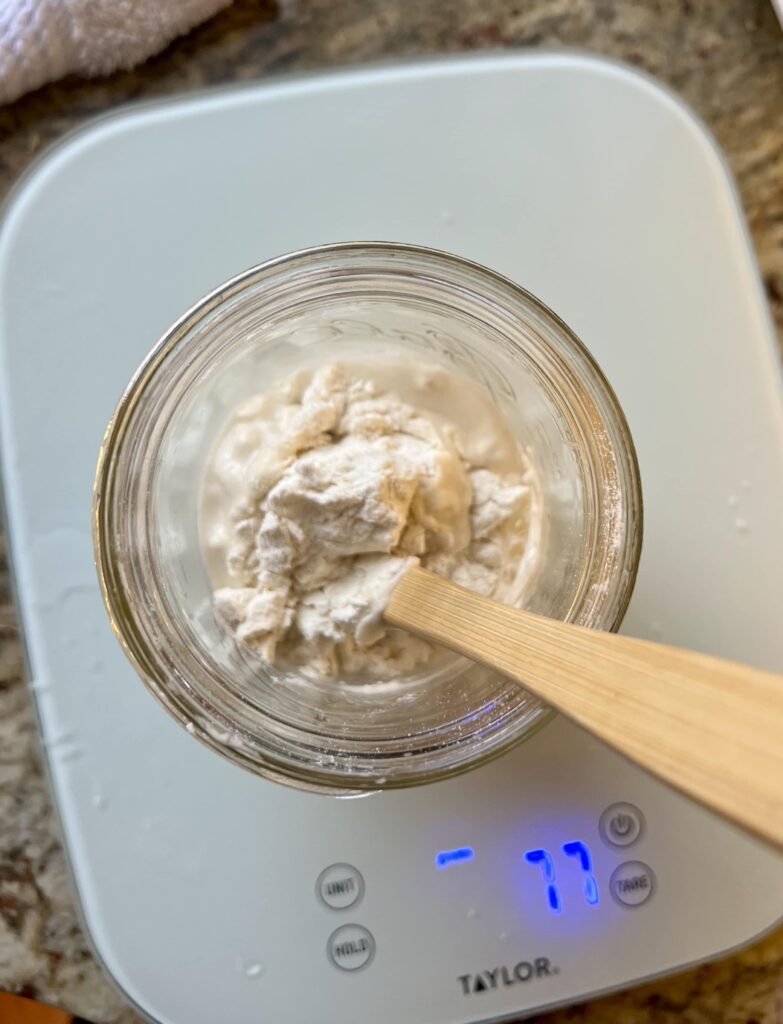
Begin Bulk Fermentation: Fermentolyse
As soon as the levain is ready (bubbly, doubled in size, peaked), mix together ripe levain, bread flour, whole wheat flour and water. This is called a “fermentolyse” and helps strengthen the gluten strands in the dough, giving a better overall texture and crumb to this bread. Cover the dough, set it in a warm (78°F) place and let it rest for 30 minutes.
After 30 minutes, add the salt and 25 grams of reserved water. Pinch chunks of dough and reincorporate them together gently. Pick up one side of the dough and fold it over on itself. Wet your hands as needed and continue to work with the dough, gently kneading until all the ingredients are incorporated and the dough is smooth. This will take about 3-5 minutes. Transfer the dough to a plastic container or a glass bowl if desired.
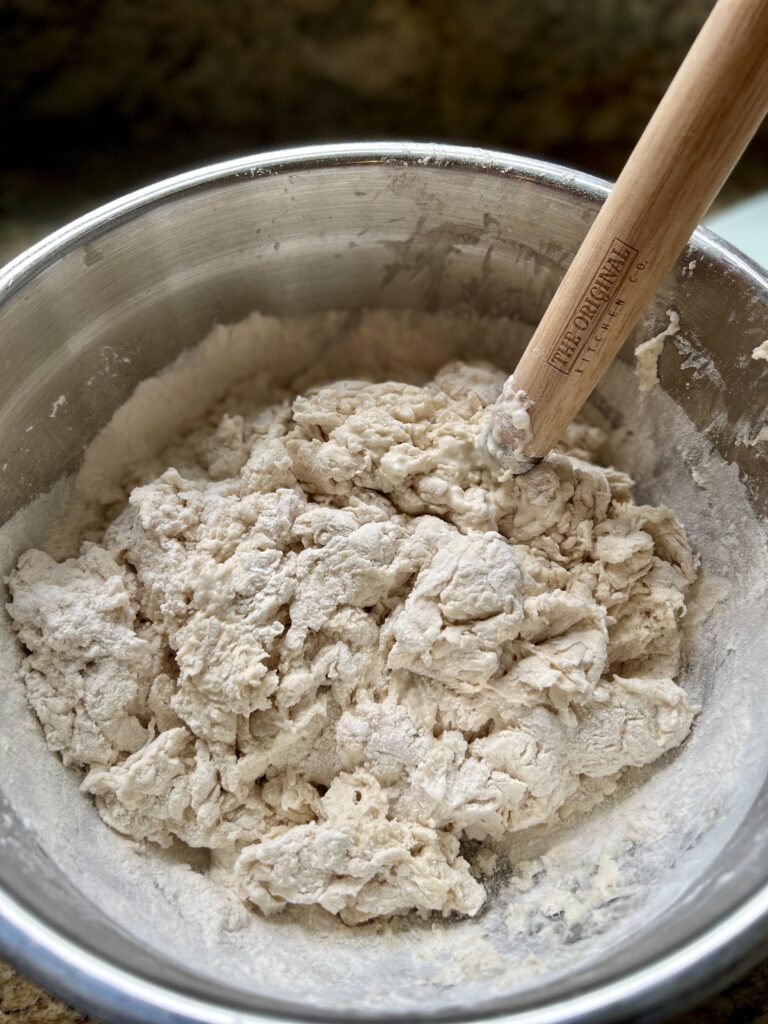
Bulk Fermentation: Stretch and Folds
For artisan style bread, we don’t use traditional kneading methods. Instead we use a series of gentle folds to help strengthen the gluten strands in the dough. This dough usually gets about 3-4 sets of stretch and folds over a 2 hour period, if the dough is kept right around 78°F.
Stretch and Fold: To “stretch and fold,” wet your hand (so it doesn’t stick to the dough). Reach down to the bottom of the bowl of dough and pull the dough up and over the top of the dough. Turn the bowl a quarter turn and repeat the stretch and fold. Turn another quarter turn and repeat. Perform one more quarter turn with stretching and folding the dough. Cover and set aside for 30 minutes. Repeat every 30 minutes for a total of 3-4 times.

Adding Cheese to Three Cheese Sourdough Bread
Right before your second set of stretch and folds, add the shredded cheeses on top of the dough. As you stretch and fold the dough, the cheese will begin to incorporate. Alternatively, you can use coil folds to mix the cheese in if you prefer. Repeat another set or two of stretch and folds until the cheese is evenly spread throughout the dough.


Bulk Fermentation: Resting and Pre-Shaping the Dough
Rest: After the 2-hour period of stretch and folds, let the dough rest in a warm 78-80°F place until puffed up and jiggly with a few scattered bubbles around the top. This usually takes 1.5-2 hours. If the dough doesn’t look like this, give it another half hour and check again.
Pre-Shaping: Once the dough has rested and is showing signs of readiness, dump the dough out on the counter. Wet your hands (and the bench knife if needed) and push the bench knife under the dough on one side, with your free hand on the other side to tuck the dough under itself. Turn the dough tightly on the counter until it forms a smooth round ball. Let the dough sit for about 30 minutes, uncovered. It will flatten out a little bit during this time and will be ready for shaping.


Shaping the Dough
Prepare a banneton or small bowl. Place a kitchen towel or hair net in the bowl and liberally flour. If you use the hair net, you should not need to use much if any flour if using a cold ferment. Using the bench knife, lift the dough up off the counter and place it on top of the countertop, floured side down. Pull the dough down toward you and then fold up to the middle of the dough. Take the right edge and pull out and then into the middle of the dough. Take the left side of the dough and stretch out and then back to the middle. Repeat with the top of the dough, forming a little “package” of dough. Gather the bread into a circle or oval and lift the bread, placing it in your lined bowl.


Cold Fermenting the Dough
I almost always use a cold fermentation for my sourdough artisan bread, and the same goes for this three cheese sourdough bread. Cover the dough and place in the refrigerator for 12-20 hours. If you leave it a little longer than that – up to 48 hours, it may overproof but will still taste good.
Want to skip cold fermentation and bake the same day you mix the dough? Leave the dough to continue rising in a warm place for a few hours until puffy, jiggly and risen. Pre-heat oven and bake.
Baking Three Cheese Sourdough Bread
Pre-heat the Oven: Put a Dutch oven (top and all) into the oven and preheat to 500°F. Allow the Dutch oven to heat for about 30 minutes to an hour at 500°F. This builds up steam, which is necessary to achieve the beautiful oven spring and perfect crust that artisan bread is known for.
Scoring the Dough: Once the oven is preheated for 30 minutes, pull the loaf out of the refrigerator. Remove the plastic wrap (this is easy to do straight out of the refrigerator if the dough is chilled – not easy if the dough warms up) and place a piece of parchment paper on top of the bread dough. Flip the dough over so that it is now sitting on the parchment paper. Take off the bowl/banneton and kitchen towel. Smooth the flour over the top of the dough and use a bread lame or very sharp knife to score the dough. I find a simple score is best when working with this dough.
Baking the Bread: Carefully remove the Dutch oven from the 500°F oven with hot pads. Take the top off and place your bread into the Dutch oven (including parchment paper – this helps with the transfer). Be very careful not to touch the sides of the hot Dutch oven. Put your hot pads back on before you pick up the lid of the Dutch oven and place it on top of the bread. Put the whole Dutch oven back into your oven. Lower the temperature to 450°F and bake for 25 minutes. Once 25 minutes are up, take the top off the Dutch oven and continue baking for 20 minutes until the bread is fully baked. Let cool before slicing and enjoy!


Amy’s Recipe Tip
You can use any favorite cheese in this recipe. Keep in mind that, when baked, some cheeses lose some of their flavor, mellow in flavor or change their flavor. for this reason, I like to use sharper cheeses in this loaf.
Substitutions
- Levain: If you prefer to not use the levain method, replace levain with sourdough starter.
- Whole Wheat Flour: Replace whole wheat flour with bread flour and give a little extra time for the fermentation process.
- Cheese: Substitute any favorite cheese for the cheese in this recipe.


How to Store Leftovers
Leftover sourdough bread can be sliced and stored in the freezer. I often leave our bread at room temperature for up to 24 hours. After that, I’ll freeze it whole or slice and freeze. Stick pieces of parchment between slices if you don’t want them to stick together. Toast from frozen or thaw to enjoy.
If you liked this, you’ll also like…
Frequently Asked Questions
Yes. You can open-bake the bread with steam in your home oven. Read more about that method here.
The way this recipe is written, it is not recommended to leave the dough on the counter overnight because it could easily over-proof. If you want to make an overnight loaf, reduce the levain or starter in the recipe to 50 grams instead of 100 grams. Let the dough bulk ferment overnight before shaping, chilling for a few hours and baking.

Three Cheese Sourdough Bread
Save this for later!
Ingredients
Levain (1:1:1, 3-4 hours at 78ºF )
- 35 grams ripe sourdough starter, about 2 Tablespoons
- 35 grams bread flour, about 1/4 cup
- 35 grams water, about 2 Tablespoons
Three Cheese Sourdough Bread
- 100 grams ripe/bubbly/peaked levain, scant 1/2 cup
- 450 grams bread flour, about 3 1/4 cup
- 50 grams whole wheat flour, about 1/3 cup
- 375 grams water, 25 grams reserved for after fermentolyse, about 1 1/2 cups water (plus 1 Tablespoon reserved for after fermentolyse)
- 10 grams salt, about 1.5 teaspoons
- 50 grams Parmesan cheese, shredded, about 1/2 cup
- 50 grams Gruyere cheese, shredded, about 1/2 cup
- 100 grams sharp cheddar cheese, shredded, about 1 cup
Instructions
Levain (1:1:1, 3-4 hours at 78ºF)
- Mix Levain: Mix together ripe/active sourdough starter with bread flour and water. Cover loosely and let sit 3-4 hours at 78°F until doubled, bubbly & peaked.
Three Cheese Sourdough Bread (keep dough at 78-80ºF to follow baking schedule)
- Fermentolyse: Once the levain is ready (bubbly, doubled in size, milky sweet smell), mix together 100 grams levain, 350 grams water (warm the water if the ingredients are too cold and cool water if the ingredients are too warm), 450 grams bread flour and 50 grams whole wheat flour. Let rest for 30 minutes.
- Mixing the Dough: After 30 minutes, add the reserved 10 grams salt and 25 grams of water. Combine using your hands by squeezing the dough between your fingers, pinching chunks of dough and reincorporating together. The dough will break apart and then reform in the bowl through this process. Pick up one side of the dough and fold it over on itself. The dough will be sticky. Wet your hands as needed and continue to work with the dough until all the salt and water has been incorporated. Continue mixing for about 3-5 minutes until thoroughly combined. Transfer the dough to a plastic container or a glass bowl and cover.
- Stretch and Folds: Perform a series of “stretch and folds” throughout the next 2 hours. The goal is to strengthen the dough. To “stretch and fold,” wet your hand (so it doesn’t stick to the dough). Reach around the dough down to the bottom of the bowl, pull the dough up and over and place it on top of the dough. Turn the bowl a quarter turn and repeat the stretch and fold. Turn another quarter turn and repeat. Perform one more quarter turn, stretching and folding the dough. Cover and set aside. Take note of how the dough feels through this process. It will go from feeling a little shaggy to smooth and elastic. Cover the bowl and wait about 30 minutes in between stretch and folds.
- Stretch and fold #1: 30 minutes into bulk fermentationShred the Parmesan, Gruyere and sharp cheddar cheeses and set aside.Stretch and fold #2: 30 minutes later – during this stretch and fold, dump the shredded cheeses on top of the dough. Perform stretch and fold #2, adding the cheese in as you fold. Stretch and fold #3: 30 minutes later, the dough will spread out. Stretch and fold again, incorporating the cheese into the dough.Stretch and fold #4: Optional, if you feel your dough needs it, stretch and fold again, mixing in the cheese as you go.
- Rest: Cover the dough and let rise for 1.5-2 more hours. You’ll know the dough is ready to shape when the dough is puffed up, jiggles when you shake the bowl, has scattered bubbles visible on the sides and top.
- Pre-shape: Tip the bowl upside down, allowing the dough to fall onto a clean counter surface. Be gentle to avoid degassing the dough as much as possible. Wet your hands and the bench knife if needed and push the bench knife under the dough on one side and your free hand on the other side to tuck the dough under itself. The goal is to introduce some tension into the dough. Repeat this process, going around in a circle until you have a ball of dough.
- Bench Rest: Let the dough rest uncovered for about 30 minutes at room temperature. The dough will flatten (like a pancake) during this period of time. This allows the gluten in the dough to relax and prepares the dough to be shaped.
- Shaping: Prepare a bowl or banneton. Place a kitchen towel or hair net in the bowl and liberally flour as needed. Sprinkle a little flour on top of the dough. Using a bench knife, lift the dough up off the counter and place it on top of the countertop – floured side down. This ensures that the flour is staying mainly on the outside of the dough. Going around in a circle, pull the dough sideways towards you and then fold up to the top of the round. Move 90 degrees and repeat the same process pulling the dough sideways and then folding up to the top. As you continue this process around the dough, increase the tension as you pull. Gather the bread into a circle and place into a lined bowl. Note: It is possible to shape the dough without any extra flour. The dough can stick to the kitchen towel but doesn't stick to the hair nets if cold proofed.
- Cold Fermentation: Cover the dough with the tea towel/shower cap/plastic wrap and refrigerate overnight or up to 14-20 hours. If you want to bake the same day, you can let the dough rise for about 3-4 hours until puffed up and risen. Then bake according to recipe directions.
- Preheat the oven: Put a Dutch oven (top and all) into the oven and preheat to 500°F for 30 minutes. You are working with very high temperatures, so make sure you have some good hot pads. Once preheated for 30 minutes, pull the loaf out of the refrigerator. Remove the covering. Place a piece of parchment paper on top of the dough. Flip the dough over so it is now sitting on the parchment paper. Take off the bowl/banneton and the kitchen towel.
- Scoring: Use a very sharp knife or bread lame to score the dough. Take the bread lame and score on one side of the dough, at a shallow angle about 30º and 1 inch deep. Score straight from the refrigerator on the cold dough for best results.
- Baking: Carefully remove the Dutch oven from the 500°F oven. Take the lid off and place your bread into the Dutch oven (including parchment paper – this helps with the transfer). Put the lid on and put back in the oven. Lower the temperature to 450°F and bake for 25 minutes. After 25 minutes, take the lid off the Dutch oven and continue baking for 20 minutes until the bread is a crackly deep brown. Remove the Dutch oven and let bread cool. Enjoy!
Notes
Nutrition
Nutrition information is automatically calculated, so should only be used as an approximation.


We LOVE this bread. The first time I made it was 7/14/25. I have been asked to bring it to a party and make it for a friend recovering from surgery. I have tried different cheeses and it always tastes delicious!!!
Under the Sourdough Baker’s Timeline and How to Make Three Cheese Sourdough Bread, the Levain is made with 40g starter, 40g water, and 40g bread flour but in the Recipe the weights are 30-30-30. Which is correct or does it matter?
How long or to watch degree to I have to wait for all sourdough breads need to cool?
Thank you Amy! You are simply The Best!
Thanks for pointing out that oversight – as long as it is a 1:1:1 ratio, it doesn’t matter. Thanks for the review!
Thank you!
My typos!
How long or to what degree do I have tyo wait for all sourdough breads need to cool before cuttinb?
You’ll want to wait until your loaf is completely cool (no longer warm to the touch). Cutting into warm bread can cause it to be gummy. I usually wait about 2 hours.
Hi Amy! Can I use store bought shredded cheeses or do I have to shred my own? Thank you!
We always recommend shredding your own. Pre-shredded cheese has anti-caking agents that makes it less melty and gives a chalky residue. If it’s all you have, you can use pre-shredded, but we definitely think it makes a difference in taste and texture.
OKAY, this recipe is right up there with that croissant loaf. I’m going to be banned from the kitchen if this keeps up.
I doubled it, and used 200g freshly shredded sharp cheddar, and cubed 100g/100g of a couple Kerry Gold cheddars. I went with the 1:10:10 levain and let it go for 12 hours at 78F. Folded the cheese per instructions, gave it four stretch and folds, and split the dough during preshape. Baked one batard in a dutch oven and the other in a Circulon loaf pan (with a second pan on top, secured with an 8″ silicone band length-wise during bake). 30 lid on, 20 lid off.
Turned out AMAZING! The loaf pan dough temp still measured at around 170 when I pulled the batard, so I had to bake it for another 15-20 minutes. The crumb was more dense than the batard, which was expected but I think another 5 minutes to bake would not have hurt.
Yum! Thanks for the review and your notes.
Do you think I could split this in two and bake two smaller loaves? Currently making 3 loaves lol. So far so good.
I think that should work!
Perfect .
Thanks for the review!
Love the flavor of this bread. Thanks for sharing!
Thanks for the review! I’m glad it’s great.
Why is this recipe different than the one in your “Beginners Guide to Sourdough ” cookbook? Here you say to bake @ 500º but in the cookbook it’s 425º.
Can you please explain so I can understand?
Hi Sandy! This is a different loaf than the recipe in my cookbook. I am contractually obligated to not share the cookbook recipes on my website, so the three cheese bread recipe in my cookbook is an easier version of this recipe that I already had on my website. This recipe follows my classic sourdough bread: https://amybakesbread.com/sourdough-basic-country-artisan-bread/ which calls for preheating the oven to 500ºF and then reducing the temperature to bake at 450ºF throughout the bake. Hope that helps!